
Introduction
NRI house construction problems in Kerala often begin after plans are approved. Within months, overseas homeowners face delays, cost jumps, and execution gaps they never expected.
For NRIs in the UK, Europe, and GCC, distance turns small site issues into major stress.
Distance increases construction risk when documentation and supervision are weak.
In Kerala, residential construction depends heavily on daily site decisions. Unlike turnkey housing markets, many outcomes rely on supervision, verbal coordination, and local judgment.
Unpopular truth: Most construction disputes are not design failures—they are process failures.
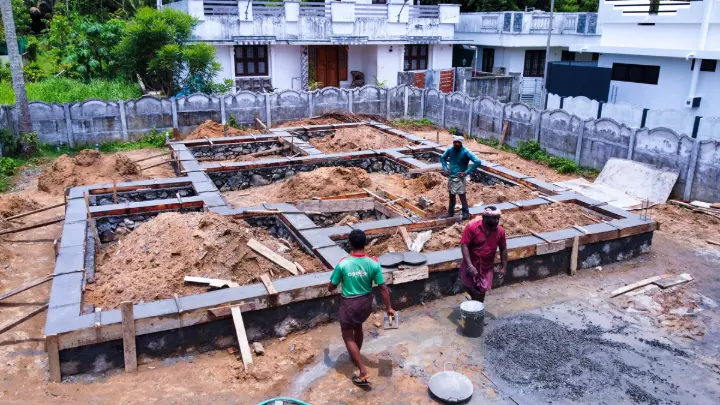
Limited Physical Presence
Absence on site leads to quality drift and silent compromises.
NRIs cannot:
- Inspect reinforcement before concreting
- Verify material brands delivered
- Catch workmanship shortcuts early
Trade-off: Remote decision-making saves travel cost but increases rework risk.
Supporting Issues NRIs Commonly Face
Verbal instructions fail without written drawings and logs.
WhatsApp photos lack scale, context, and accountability. Decisions made without drawings often get misinterpreted on site.
Coordination Breakdowns
Claim: Multiple vendors without one controller cause delays.
Electricians, plumbers, contractors, and suppliers need daily alignment. Without a central professional lead, tasks clash.
Local detail: Kerala contractors often juggle multiple sites simultaneously.
Budget Misunderstandings
Undefined scope causes budget creep, not material prices.
Remote approvals lead to:
- Late design changes
- Material substitutions
- Add-on work outside original scope
Regulatory and Approval Issues
Approval errors can stop work entirely.
Local panchayat rules, permits, and documentation require constant follow-up.
Unpopular truth: Many delays are approval-related, not contractor-related.
Common Mistakes and Red Flags
NRIs often trust relationships over systems.
Red flags to watch for:
- No detailed working drawings
- Site decisions not recorded
- Costs shared verbally only
- No clear responsibility chart

Case Study / Field Note
Process control matters more than presence.
During our own projects, we noticed that NRI homes with weekly reports, drawings, and site photos had fewer disputes—even when clients never visited the site.
At R+A Architects, projects with structured documentation showed smoother execution and predictable costs.
Actionable Checklists & Frameworks
Before Construction Starts
Preparation prevents 70% of site conflicts.
Do this now:
- Step 1: Finalize detailed working drawings
- Step 2: Lock material specifications
- Step 3: Define scope boundaries
Proof you keep: Signed drawings + dated specs
During Construction
Written updates reduce misunderstandings.
Do this now:
- Step 1: Weekly site reports
- Step 2: Photo documentation
- Step 3: Cost variation log
Proof you keep: Weekly PDF reports
Framework Table: Control vs Risk
| Item | Value (unit) | Date |
| Weekly site reports | 1 per week | 2025 |
| Cost overrun risk without architect | High (%) | 2025 |
| Rework probability | Medium–High (%) | 2025 |
FAQs
Q1.I’m abroad. How can I monitor the work properly?”
You need a structured supervision system: weekly site reports, photo/video updates, milestone checklists, and independent quality inspections at key stages (foundation, slab, plaster, waterproofing, flooring, MEP). Avoid depending only on WhatsApp updates from a contractor.
Q2. Why do costs increase unexpectedly?
Because scope changes and material decisions are made remotely without technical clarity.
Q3.How do I prevent material substitution (duplicate/low quality)
Do these:
- Finalize brand/spec before purchase
- Get invoice + batch/brand photos
- Keep a material approval sheet (tile code, paint shade, fittings model)
-
Random checks by an engineer/PMC
Most substitutions happen when specs aren’t written.
Q4. What is the biggest hidden risk?
Lack of written records for site decisions.
Q5. How can trust be maintained remotely?
Through transparency, reports, and accountability systems.
Q6.Should I buy materials myself or let contractor handle?”
If you want control, buy major visible items yourself (tiles, sanitary, lights) with professional guidance. For civil materials (cement, steel), either way works—but tracking and approvals must be systematic.
About the Author
Mohammed Rashid
Founder & Principal Architect, R+A Architects
Mohammed Rashid, Founder & Principal Architect at R+A Architects, holds a B.Arch from Anna University. With 60+ projects across India, Dubai, and Europe, and awards including India Design 2023 and Stellar Design 2024, he champions modern Kerala architecture rooted in climate, comfort, and culture.
in Architecture
Related Reading
- Architectural Services in Perinthalmanna, Kerala
- Architecture & Design Insights for Kerala Homes & Businesses
Explore next:
- How a Good Architect Can Simplify the Complexities of Building Permits
- Kerala Coastal Zone Management Authority.
- Build Your Luxury NRI Villa in Kerala with Complete Design + PMC Support