
A successful commercial facade attracts attention while supporting comfort, branding, safety, and long-term maintenance
A commercial facade is the visible exterior face of a business building. It creates the first impression customers receive and can influence whether a business appears professional, dependable, modern, premium, or welcoming.
The best commercial facade design ideas combine appearance, functionality, and brand identity. Glass curtain walls, metal screens, natural stone, terracotta, wooden accents, green walls, lighting, and signage can all improve a business building when used with a clear purpose.
An effective facade should:
- Make the entrance easy to identify
- Create a professional first impression
- Reflect the company’s image
- Protect the building from sun and rain
- Allow useful natural light
- Reduce glare and unwanted heat
- Support clear signage
- Allow safe cleaning and maintenance
For business owners and property developers, the main question is not simply which facade looks the most modern. The better question is which design suits the site, climate, customer experience, budget, and long-term maintenance needs.
For r plusarchitect, facade design is part of the complete building experience rather than a decorative layer added after planning is finished.
Why Commercial Facade Design Matters
A commercial facade affects customer trust, building recognition, indoor comfort, and future maintenance costs.
Customers begin forming an opinion about a business before they enter the building. The entrance, colours, signs, lighting, cleanliness, and condition of the exterior all influence that opinion.
It creates a strong first impression
A clean and well-planned facade can communicate professionalism. A damaged sign, hidden entrance, exposed wiring, or neglected wall can create doubt.
A commercial building does not always need expensive materials to look attractive. Clear proportions, consistent colours, suitable lighting, and an easy-to-find entrance can improve even a small property.
It makes the building easier to recognize
A recognizable building is easier for customers to locate and remember. This is especially useful for businesses on busy roads or in areas where several buildings look similar.
Recognition may come from:
- A strong entrance frame
- A distinct colour combination
- A repeated screen pattern
- Clear illuminated signage
- A memorable canopy
- Controlled nighttime lighting
It reflects the company’s identity
Different businesses need different visual messages.
A clinic may need to feel calm and dependable. A technology office may aim for a clean and precise appearance. A hotel may need warmth, comfort, and a strong evening presence.
The facade should express these qualities without turning the whole building into a large advertisement.
It affects indoor comfort
Window size, glass selection, shading, and wall construction influence daylight, heat, glare, and privacy.
Large glass areas can look impressive, but they may create uncomfortable indoor conditions when direct sunlight is not controlled. External fins, screens, canopies, recessed windows, and suitable glazing can reduce these problems.
It influences long-term expenses
Every panel, joint, light fitting, planter, sign, and glass surface will eventually need cleaning, repair, inspection, or replacement.
Unpopular truth: A facade that cannot be cleaned or repaired safely is not a successful design, even if it looks impressive when first completed.
Commercial Facade Design Ideas
The best facade designs give every material and architectural element a clear visual or practical purpose
1. Shaded glass facades
Glass is commonly used for offices, retail buildings, showrooms, and commercial complexes. It can make a building appear open, modern, and professional.
Transparent glazing may also help customers see products, displays, or activity inside the building. This can be useful for showrooms, cafés, and retail stores.
However, large areas of unshaded glass may increase indoor heat and glare. Instead of depending only on dark or reflective glass, consider adding:
- Vertical fins
- Horizontal overhangs
- External louvers
- Deep window recesses
- Perforated screens
- Entrance canopies
The orientation of the building should guide the shading design. East- and west-facing windows often receive strong low-angle sunlight.
Best for: Offices, showrooms, financial businesses, technology companies, and premium retail.
Trade-off: Glass improves transparency and natural light, but it may increase cooling and cleaning needs.
2. Perforated metal screens
Perforated metal panels can provide shade, privacy, security, and visual interest. They can also help a business create a recognizable pattern.
Possible designs include:
- Geometric patterns
- Abstract forms
- Repeated brand symbols
- Regionally inspired motifs
- Simple linear openings
The screen may be positioned in front of windows, staircases, parking areas, or solid walls. During the day, it creates changing shadows. At night, lighting behind the screen can make the pattern more visible.
Before selecting a metal-screen system, review:
- Panel size
- Wind resistance
- Fixing methods
- Corrosion protection
- Cleaning access
- Rainwater drainage
- Replacement procedures
Best for: Offices, restaurants, shops, parking structures, and mixed-use properties.
Local detail: Aluminium or properly protected metal may be easier to maintain in humid areas than poorly coated steel.
3. Natural stone cladding
Natural stone can give a business building a stable and premium appearance. It works particularly well at entrances and lower levels where walls are more likely to be touched, scratched, or stained.
Stone may be used on:
- Entrance portals
- Ground-floor walls
- Feature columns
- Reception-facing elevations
- Signage backgrounds
- Landscape walls
Stone does not need to cover the complete building. Using it selectively can reduce cost while still creating a strong visual effect.
Best for: Hotels, banks, jewellery stores, clinics, offices, and formal commercial buildings.
Warning: Stone panels require suitable anchors, joints, edge details, and professional installation.
4. Terracotta fins and screens
Terracotta can add warmth, texture, and regional character to a commercial facade. It works well with concrete, stone, metal, and controlled areas of glass.
Terracotta may be used as:
- Vertical fins
- Hollow blocks
- Jaali screens
- Rainscreen tiles
- Shading panels
- Feature walls
Its natural colour variation can make a commercial building feel less artificial.
Best for: Offices, hotels, schools, clinics, cultural buildings, and businesses seeking a regional identity.
Local detail: Terracotta tones often suit Kerala’s green landscape and red-soil surroundings. The joints and support system must still be designed for heavy rain and humidity.
5. Wood accents and wood-look panels
Wood tones can make a business building feel warmer and more welcoming. They are often used around entrances, under canopies, behind signs, or across selected facade areas.
Natural exterior timber may require regular care in exposed or humid locations. Alternative materials include:
- Wood-finish aluminium
- Exterior-grade fibre-cement boards
- Ceramic wood-look panels
- Treated engineered boards
- Approved exterior laminates
Wood-look products should follow believable panel sizes and grain directions. Random joints or repeated printed patterns may make the finish appear artificial.
Best for: Cafés, salons, boutique offices, wellness centres, resorts, and lifestyle stores.
Trade-off: Natural timber provides authentic texture, while alternative products may be easier to maintain.
6. A clearly framed entrance
The entrance is one of the most important parts of a commercial facade. Customers should be able to locate it quickly from the road, parking area, or footpath.
A clear entrance can be created with:
- A deep portal
- A large canopy
- Contrasting materials
- A double-height frame
- Focused lighting
- A change in paving
- A recessed doorway
- A visible sign
The entrance should also protect customers from sun and rain. In areas with heavy monsoon weather, the canopy should be deep enough to provide practical shelter.
Best for: Every type of commercial building.
Unpopular truth: Improving the entrance often provides more value than decorating the entire facade.
7. Green walls and planted facades
Planting can soften hard building surfaces and improve the experience around entrances, offices, cafés, hotels, and wellness businesses.
Green facade options include:
- Ground-level planting beds
- Climbing plants on trellises
- Balcony planters
- Planted ledges
- Modular green-wall systems
- Shade trees
A successful green facade needs:
- Suitable plants
- Irrigation
- Drainage
- Root control
- Maintenance access
- Plant replacement
- Protection from water staining
A simple planter or trellis system may be more practical than a complete vertical garden.
Best for: Restaurants, hotels, campuses, wellness centres, and office buildings.
Warning: A green wall without an upkeep plan can quickly become damaged, dry, or stained.
8. Branded colour blocks
Colour is one of the simplest ways to make a commercial building recognizable. However, it should be used with control.
A balanced approach is to use a neutral base and apply the company’s main colour to selected areas such as:
- Entrance frames
- Canopies
- Sign panels
- Vertical fins
- Door surrounds
- Feature walls
- Balcony edges
Very bright colours may fade or show dirt more easily. They may also make future tenant changes more difficult.
Test colours on full-size outdoor samples. A finish can look different under direct sunlight, shade, rain, and artificial lighting.
Best for: Shops, clinics, offices, service centres, and multi-location businesses.
Trade-off: Strong colours improve recognition, while neutral materials often remain suitable for longer.
9. Architectural lighting
Facade lighting can improve visibility, safety, and nighttime identity. It should highlight the entrance and important architectural elements rather than illuminate every surface equally.
Useful lighting approaches include:
- Entrance lighting
- Wall washing
- Sign backlighting
- Recessed canopy lights
- Linear lighting
- Lighting behind screens
- Landscape lighting
Cables, electrical drivers, junction boxes, and maintenance access should be planned before construction.
Best for: Hotels, restaurants, retail stores, clinics, offices, and entertainment buildings.
Trade-off: Brighter lighting may improve visibility, but excessive light can increase operating costs and disturb neighbouring properties.
10. Mixed-material facades
Many successful commercial facades combine two or three main materials.
Examples include:
- Glass, metal, and stone
- Terracotta, concrete, and glass
- Neutral plaster, wood-look panels, and signage
- Stone, planting, and warm lighting
Each material should have a clear purpose.
A practical material system may include:
- One main background finish
- One material to highlight the entrance
- One element for shade or branding
Avoid adding several unrelated finishes only to make the building appear more detailed.
Best for: Large offices, showrooms, retail buildings, hotels, and mixed-use properties.
Unpopular truth: More materials often create more joints, alignment problems, colour differences, and maintenance work.
Commercial Facade Materials Compared
Facade materials should be compared by cost, maintenance, climate response, visual impact, and replacement needs.
The following scores are general planning indicators. They are not contractor quotations.
Facade option | Relative cost (1–5) | Maintenance effort (1–5) | Brand impact (1–5) | Main consideration |
Shaded glass | 4 | 3 | 4 | Heat, glare, seals, and cleaning |
Perforated metal | 3 | 2 | 5 | Corrosion and fixing details |
Natural stone | 4 | 2 | 4 | Weight, anchors, and joints |
Terracotta screens | 3 | 2 | 4 | Support and replacement |
Wood-look panels | 3 | 2 | 4 | Fading and joint quality |
Green facade | 4 | 5 | 5 | Irrigation and maintenance |
Entrance portal | 2 | 1 | 5 | Visibility and rain protection |
Architectural lighting | 2 | 2 | 5 | Glare, access, and energy use |
How to select the right facade option
Score each material or system from one to five against the following project needs:
- Customer visibility
- Climate suitability
- Initial budget
- Maintenance capacity
- Brand character
- Local availability
- Safety
- Cleaning access
- Ease of replacement
- Expected service life
Do not choose a facade material only because it has the lowest quotation. A cheaper product may become expensive when repainting, water damage, difficult access, or early replacement is considered.
How Facades Support Branding and Signage
Brand identity is strongest when it appears through the entrance, materials, proportions, signage, and lighting—not only through a logo
A commercial facade should communicate the character of the business in a clear and controlled way.
A healthcare building should feel calm, clean, and dependable. Light colours, a visible entrance, controlled glass, and simple signage can help create a reassuring appearance.
A technology office may benefit from clean lines, metal screens, controlled glazing, and a limited colour palette. These features can communicate precision and a modern working environment.
Hotels should appear welcoming during both the day and evening. Warm materials, planting, covered entrances, layered lighting, and clear drop-off areas can improve the guest experience.
Jewellery showrooms often require a premium and secure appearance. Natural stone, metal details, focused display glazing, strong entrance frames, and controlled lighting may be suitable.
Restaurants and cafés can use wood tones, warm lighting, planting, visible entrances, and weather-protected outdoor areas to create an approachable atmosphere.
Financial offices usually need to communicate stability and professionalism. Neutral colours, stone accents, simple proportions, clear signs, and a strong entrance can support this image.
Plan signage during the design stage
Signage should be included in the facade concept rather than added after construction.
Review:
- Viewing direction
- Reading distance
- Road speed
- Pedestrian approach
- Sign size
- Day and night visibility
- Electrical supply
- Maintenance access
- Local signage rules
- Space for future tenant changes
Create a clear sign hierarchy
A multi-tenant building can become visually confusing when every tenant uses a different sign size, colour, font, and lighting style.
A coordinated signage system should define:
- Main building sign
- Tenant signs
- Direction signs
- Parking signs
- Entrance signs
- Service and safety signs
Trade-off: A highly branded facade may improve recognition, but it can make future tenant or business changes more expensive.
Responsive and Energy-Conscious Facades
A climate-responsive facade controls direct sun, glare, and rain while allowing useful daylight and outward views
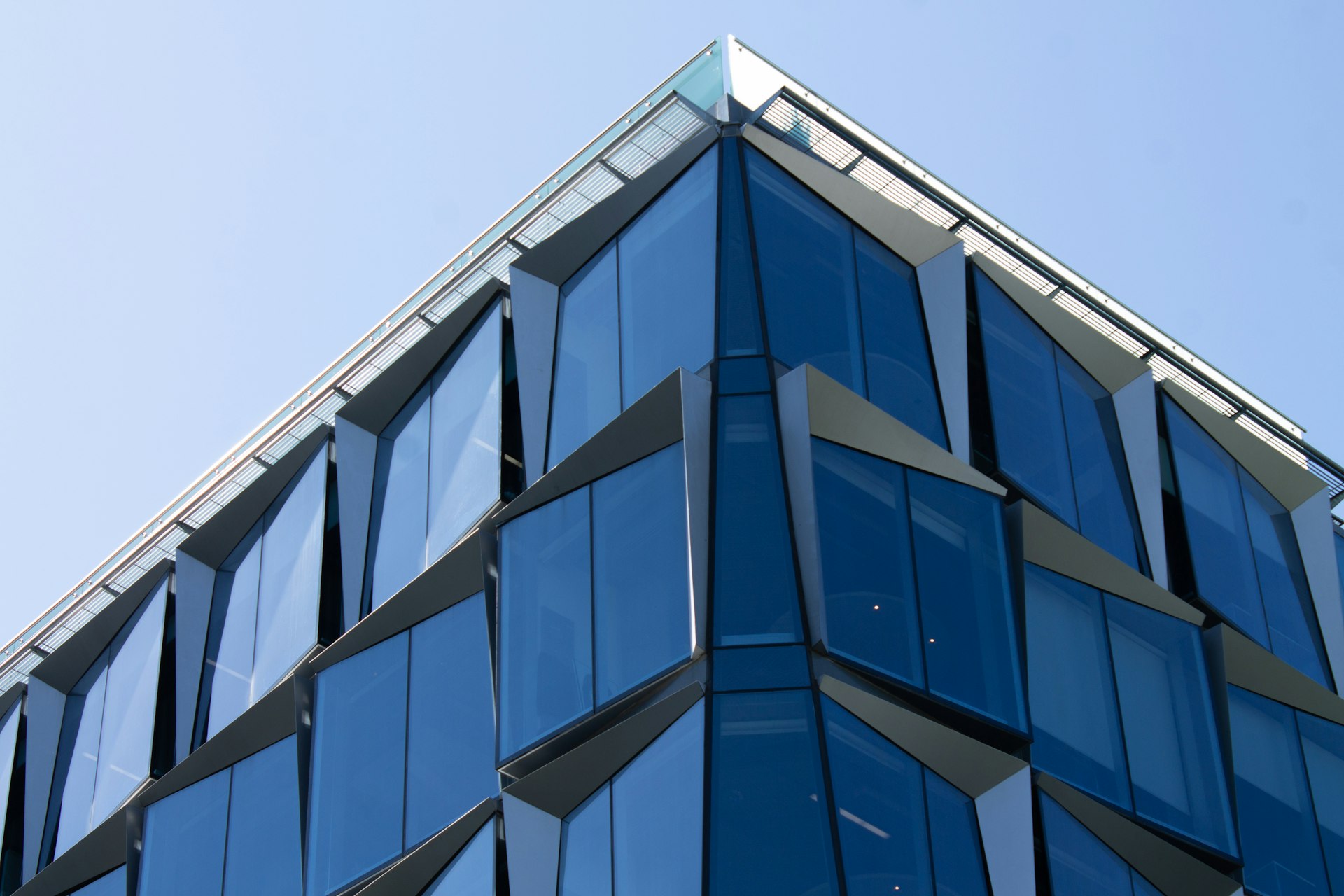
A commercial facade influences how much heat and daylight enter the building. This can affect indoor comfort, cooling needs, and artificial lighting use.
Control sunlight before it reaches the glass
External shading can block direct sunlight before heat enters the building.
Useful shading elements include:
- Roof overhangs
- Vertical fins
- Horizontal louvers
- Perforated screens
- Terracotta screens
- Recessed windows
- Trees and climbing plants
The size and direction of the shading should respond to the building’s orientation.
Use natural light carefully
More glass does not always create better daylight.
Useful daylight depends on:
- Window height
- Glass clarity
- Room depth
- Interior colours
- External obstructions
- Shading
- Furniture position
- Glare control
High-level windows can sometimes bring light deeper into a room than full-height glazing near the floor.
Control air and water leakage
Water often enters through connections rather than through the centre of a wall.
Important junctions include:
- Glass to frame
- Frame to wall
- Wall to roof
- Cladding to structure
- Sign to wall
- Light fitting to cladding
- Window sill to drainage channel
These areas need suitable slopes, seals, flashings, joints, and drainage paths.
Respond to Kerala’s climate
Commercial buildings in Kerala should consider:
- Heavy seasonal rain
- Wind-driven water
- High humidity
- Strong sunlight
- Algae and fungal staining
- Corrosion
- Blocked drains
- Plant growth
- Cleaning access
- Roof and facade maintenance
Deep shade can improve comfort, but water must not become trapped behind panels, screens, or planter systems.
Professional review advised: Structural supports, glazing, waterproofing, fire safety, accessibility, energy performance, and local approvals should be reviewed by qualified professionals.
Common Commercial Facade Design Mistakes
Many facade problems begin at joints, openings, signs, fixings, and maintenance gaps rather than at the centre of a wall.
Designing only the front elevation
Customers may also see side walls, parking entrances, service areas, roof equipment, and neighbouring elevations.
A polished front with neglected visible sides can weaken the overall appearance.
Using too much unshaded glass
Large glass areas may increase heat, glare, cleaning costs, and visibility into storage or service spaces.
Glass should be used where transparency or natural light provides real value.
Selecting materials from small samples
A small sample does not show:
- Full panel joints
- Surface reflections
- Colour variation
- Corner details
- Water streaks
- Fixing lines
- Large-scale texture
A full-size sample or mock-up provides a more accurate view.
Adding signs after construction
Late signage often leads to exposed wiring, random support frames, damaged waterproofing, and competing tenant signs.
Ignoring cleaning and repair access
Before approving a design, ask:
- How will upper glass be cleaned?
- How will lights be replaced?
- How will planters be reached?
- Can drains be cleared?
- Can damaged panels be removed?
- Can signs be repaired safely?
Hiding services without planning access
Air-conditioning pipes, drains, electrical cables, shutters, vents, cameras, and security equipment should be coordinated early.
Covering services without access can make future repairs difficult.
Copying a facade from another climate
A design that works in a cool or dry region may not suit a hot, humid, and rainy location.
Materials and details should be adjusted for local weather, maintenance capacity, and available workmanship.
Unpopular truth: A polished computer rendering does not prove that a facade can drain water, resist wind, prevent leaks, or be maintained safely.
Renovating a Kerala Commercial Building
A short site and customer audit can reveal facade problems before renovation money is committed.
Consider a three-storey retail and office building beside a busy road in Kerala.
The existing facade has reflective glass, several unrelated signs, dark cladding, visible air-conditioning pipes, and a narrow entrance canopy.
A site review may find that:
- Drivers notice the entrance too late.
- Customers wait in the rain because the canopy is too small.
- Afternoon sunlight creates glare at reception.
- Tenant signs compete with each other.
- Water collects behind sign frames.
- Exterior pipes interrupt the main elevation.
- Upper glass cannot be cleaned safely.
- Night lighting highlights signs but not the doorway.
A practical renovation could:
- Retain usable areas of glass
- Add external shade to the exposed side
- Build a deeper entrance canopy
- Create one clear signage zone
- Conceal services behind removable panels
- Add a durable ground-floor finish
- Improve entrance lighting
- Provide safe cleaning access
This approach combines appearance, function, natural light, customer appeal, energy awareness, and brand identity. Every element has a clear role.
What to check before renovation
Begin by checking whether visitors can identify the main entrance from the road, parking area, and footpath. Ask a small group of people to point out the entrance without receiving directions.
Next, test the readability of the signage from different distances and approach directions. Note where trees, vehicles, neighbouring signs, or building elements block visibility.
Indoor glare should be checked during the brightest part of the day. Speak with employees working near windows and ask them to rate glare from one to five.
Inspect the exterior during or immediately after rain. Look for water marks, blocked drains, leaking joints, damaged sealants, and water collecting behind signs or cladding panels.
The maintenance team should also check how long it takes to reach and clean different parts of the facade. Upper glass, lights, planters, drains, signs, and removable panels should be safely accessible.
Visit the property after sunset to confirm whether the doorway is easy to find and whether the lighting creates glare or leaves unsafe dark areas.
Finally, show two or three facade concepts to a small group of customers. Ask which option appears more professional, welcoming, and easy to identify.
Proof you keep: Dated photographs, visitor feedback, glare ratings, rain inspection notes, maintenance records, and approved facade samples.
Trade-off: A short audit adds time before design approval, but it can reduce construction changes and repair costs later.
Commercial Facade Planning Checklist
A facade should be approved only after its business value, climate response, safety, buildability, and upkeep have been reviewed.
1: Business and customer experience
Do this now:
- Step 1: Define the main purpose of the facade.
- Step 2: Mark the important viewing points.
- Step 3: Confirm how customers will find the entrance.
- Step 4: Establish the sign hierarchy.
- Step 5: Select two or three primary materials.
- Step 6: Test the day and night appearance.
- Step 7: Include accessibility and rain protection.
- Step 8: Show pipes, cameras, shutters, vents, and services in the design.
Proof you keep: Entrance diagram, viewing-point plan, signage plan, and material board.
2: Climate and technical review
Do this now:
- Step 1: Prepare a sun and orientation study.
- Step 2: Identify areas exposed to direct rain.
- Step 3: Confirm shade requirements.
- Step 4: Review glass and solid-wall areas.
- Step 5: Detail sills, joints, flashings, and drainage.
- Step 6: Confirm corrosion protection.
- Step 7: Coordinate cladding, signs, lights, and waterproofing.
- Step 8: Review fire, accessibility, and local approval requirements.
Proof you keep: Coordination drawings, calculations, consultant comments, and approved details.
3: Procurement and maintenance
Do this now:
- Step 1: Build a full-size material sample or mock-up.
- Step 2: View it in sunlight, shade, rain, and artificial light.
- Step 3: Request product and installation information.
- Step 4: Confirm warranty responsibilities.
- Step 5: Check replacement availability.
- Step 6: Plan access for cleaning and repairs.
- Step 7: Prepare an inspection schedule.
- Step 8: Record approved products before construction.
Proof you keep: Mock-up approval, product submissions, sample board, warranty register, and maintenance schedule.
Which Facade Improvements Offer the Most Value?
Entrance clarity, organized signage, and rain protection can provide more early value than replacing the complete facade.
ROI means return on investment—the value gained compared with the money and effort spent.
The following rankings are planning estimates. Actual results depend on the building, location, business type, and construction cost.
Improvement | Business value (1–5) | Design effort (1–5) | Cost exposure (1–5) | Likely benefit period |
Clearer entrance | 5 | 2 | 2 | Immediate to 1 year |
Coordinated signage | 5 | 2 | 2 | Immediate |
Improved rain canopy | 4 | 2 | 2 | Immediate to 10 years |
External shading | 4 | 3 | 3 | 1–10 years |
Architectural lighting | 4 | 2 | 2 | Immediate |
Durable ground finish | 3 | 2 | 3 | 3–10 years |
Complete facade replacement | 5 | 5 | 5 | 5–15 years |
Green wall | 4 | 4 | 4 | Depends on maintenance |
Where should a limited budget go first?
Prioritize:
- Water-entry repairs
- Unsafe or damaged materials
- Entrance visibility
- Rain protection
- Signage organization
- Exterior service coordination
- Entrance lighting
- Selected material upgrades
Frequently Asked Questions
What is a commercial facade?
A commercial facade is the visible exterior face of a business building. It includes walls, glazing, entrances, cladding, screens, signs, canopies, lighting, joints, and visible building services.
What makes a commercial facade attractive?
Clear proportions, a visible entrance, coordinated materials, readable signage, suitable lighting, and careful detailing make a facade attractive. It does not need complicated forms or many colours.
Which material is best for a commercial facade?
There is no single best material. Glass may suit a showroom, stone may suit a formal entrance, and metal or terracotta screens may suit a sun-exposed office.
The choice should consider climate, business type, maintenance, safety, and budget.
Is a glass facade suitable for Kerala?
Glass can be used in Kerala when suitable shading, drainage, sealing, cleaning access, and heat control are included.
Large areas of unshaded glass should be reviewed carefully.
How many materials should a facade use?
Two or three main materials are usually enough. Each material should have a clear purpose, such as forming the background, emphasizing the entrance, providing shade, or supporting signage.
Are green walls practical for business buildings?
Green walls can work when irrigation, drainage, plant replacement, access, and maintenance funding are planned.
A planter or trellis system may be more practical for businesses with limited maintenance staff.
How can a small shop improve its facade?
Start with a clear sign, protected entrance, consistent colours, concealed wiring, suitable lighting, and clean window proportions.
One well-designed entrance frame may create more impact than several cladding materials.
Can an existing commercial facade be renovated?
Yes. Common improvements include reorganizing signs, repainting, replacing damaged materials, adding shade, improving lighting, concealing services, and creating a clearer entrance.
A successful commercial facade remains attractive, recognizable, comfortable, and maintainable long after construction is completed.
Commercial facade design is about more than appearance. It should improve customer experience, reflect the brand, and protect the building from sun, rain, and daily wear.
Materials such as glass, metal, stone, terracotta, wood finishes, planting, and lighting work best when they suit the site, budget, climate, and maintenance needs.
A successful facade should have a clear entrance, coordinated materials, effective weather protection, controlled daylight, readable signage, and safe access for maintenance. The goal is a professional exterior that continues to perform well over time.
About the Author
Mohammed Rashid
Founder & Principal Architect, R+A Architects
Mohammed Rashid, Founder & Principal Architect at R+A Architects, holds a B.Arch from Anna University. With 60+ projects across India, Dubai, and Europe, and awards including India Design 2023 and Stellar Design 2024, he champions modern Kerala architecture rooted in climate, comfort, and culture.
Related Reading
- Architectural Services in Perinthalmanna, Kerala
- Architecture & Design Insights for Kerala Homes & Businesses
Explore next:
- How a Good Architect Can Simplify the Complexities of Building Permits
- Cost of Building a House in Kerala (2026 Updated)
- Build Your Luxury NRI Villa in Kerala with Complete Design + PMC Support