
How nature-first design improves comfort, well-beingwell-being, and long-term value for Kerala homes, NRI villas, and luxury developments—plus how early biophilic choices shape better living.
Biophilic architecture brings nature into everyday living, and early choices decide how well it works. For Kerala families, NRI homeowners, and developers planning villas or hospitality projects, what you finalize in the first 20–30% of design determines comfort, ventilation quality, and long-term maintenance. This guide explains how early biophilic architecture improves Kerala living.
Kerala’s humid climate, high rainfall, strong sun, and dense residential layouts make nature-responsive design more than a trend — it is practical, healthy, and economically smart. Families planning first homes want fresh air and low maintenance. NRI clients from the UK, Europe, and GCC want reassurance that design decisions made remotely still protect comfort, privacy, and long-term durability. Developers and hospitality owners look for luxury experiences that feel rooted in place, not imported.
At this stage, many people also ask how experienced studios bring biophilic architecture into real projects. One example is how R+A Architects approaches it: climate-responsive buildings that breathe naturally, courtyards for light and ventilation, green pockets along circulation, visual continuity between inside and outside, local material use, shaded openings, and landscape integrated as a core design element. This shows what “nature integration” looks like when applied consistently.
Early biophilic decisions in Kerala reduce heat, improve airflow, and lower lifetime energy demand by shaping building orientation and envelope.
Local detail: Kerala’s monsoon winds shift direction twice a year, so courtyard placement affects ventilation far more than most homeowners expect.
What Is Biophilic Architecture and Why Does It Matter in Kerala?
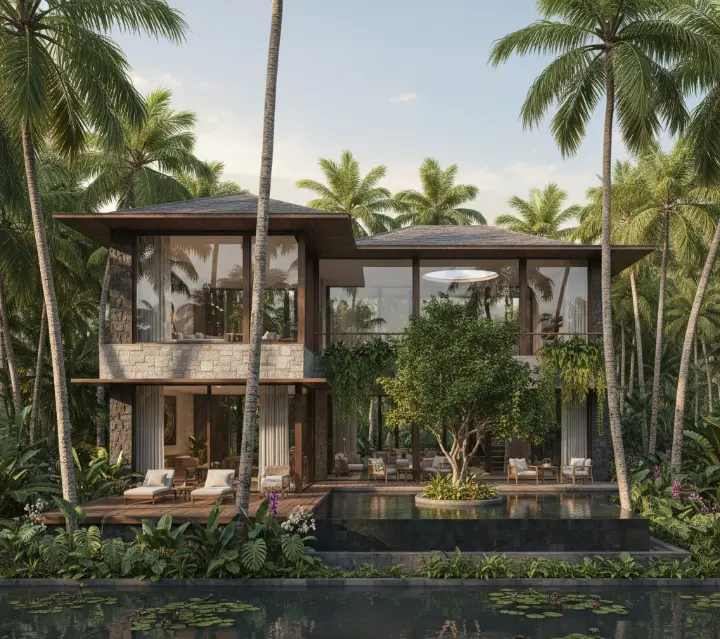
Biophilic architecture is the practice of designing buildings that keep people connected to nature—through ventilation, daylight, materials, views, and indoor–outdoor flows. In Kerala, this is not just an aesthetic preference. It directly improves comfort, reduces humidity, supports mental well-being, and cuts energy load in homes and commercial spaces.
Why It Matters for Kerala’s Audience Types
- Families & individuals want healthier air, natural cooling, and practical layouts.
- NRI homeowners need designs that perform well despite being away most of the year.
- Business owners & developers seek luxury environments where greenery becomes an experience.
Hospitality projects benefit from design that feels rooted in Kerala’s ecology.
Studios experienced in climate-sensitive work—such as R+A Architects—show how a clear biophilic strategy helps: natural ventilation planning, locally sourced materials, courtyards for light, green pockets, landscape-first thinking, and energy-efficient envelopes with shaded openings. This demonstrates how an early philosophy guides every later detail.
Biophilic architecture works best when orientation, airflow paths, and shading decisions are made before room-by-room planning begins.
LUT — Unpopular Truth: Most “green-looking” homes in Kerala fail to perform because plants are added at the end instead of being part of the architecture itself.
How Does Kerala’s Climate Shape Biophilic Architecture?
Kerala’s high humidity, monsoon seasons, and strong east–west sun require designs that breathe naturally. Buildings that ignore climate often face heat buildup, damp walls, and heavy dependence on AC.
Climate Factors to Consider
- Cross ventilation works differently pre- and post-monsoon.
- Courtyard sizes decide how much air actually circulates.
- Shading depth reduces direct solar gain.
- Open-to-sky cut-outs prevent stagnant moisture.
Cross-ventilation corridors aligned with seasonal wind directions can lower indoor temperatures by 2–4°C without mechanical cooling.
LUT — Trade-off: Deep verandahs reduce heat but also reduce indoor daylight, so balancing shade depth is critical.
What Are the Core Elements of Biophilic Architecture?
Kerala homes and luxury projects succeed when natural elements are integrated into the building’s structure, not treated as surface décor.
Core Components
- Nature-based ventilation (stack effect, cross breeze)
- Courtyards and atriums
- Native landscaping
- Water elements for microclimate
- Material palettes (stone, clay, timber, lime)
Courtyards increase usable daylight by 20–30% in dense Kerala plots.
LUT — Local Detail: Sea breeze influence is noticeable even 15–20 km inland, affecting evening ventilation patterns.
How do courtyards improve ventilation and well-being?
Courtyards are the backbone of Kerala biophilic architecture. They support airflow, daylight, privacy, and family activity.
Benefits
- Natural temperature regulation
- Multiple light sources instead of harsh single openings
- Filters dust and noise
- Acts as a central family space
- Allows controlled greenery without overgrowth
A courtyard placed slightly off-center improves airflow by creating pressure differences that move warm air upwards.
LUT — Unpopular Truth: Courtyards fail when they are too small; anything under 10–12% of the built-up area restricts ventilation.
What Materials Work Best for Biophilic Architecture in Kerala?
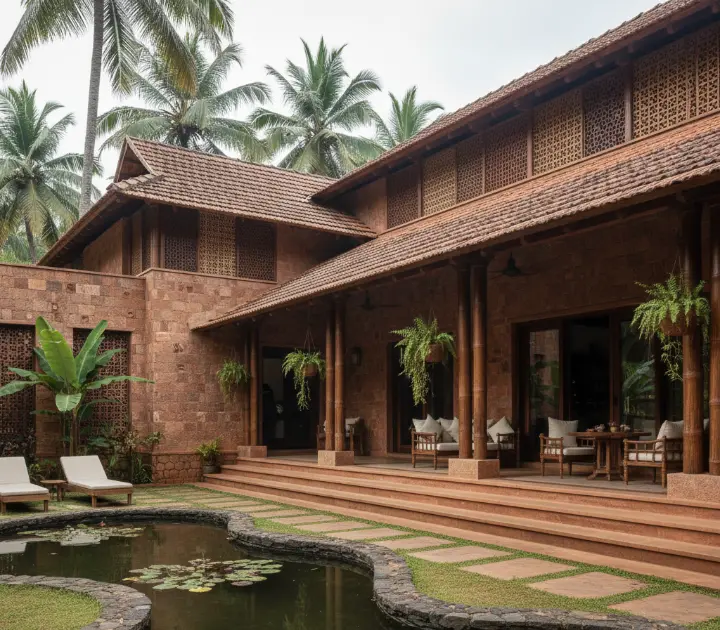
Locally sourced natural materials reduce heat, age well in humidity, and support Kerala’s craft traditions.
Useful Materials
- Laterite blocks
- Natural timber
- Lime plaster
- Clay tile roofing
- Rough-cut granite
- Terracotta screens (jaalis)
Lime plaster reduces wall surface temperature by up to 3°C compared to cement-based plaster.
LUT — Trade-off: Natural materials require skilled labor; costs rise 8–12% if workers lack experience.
How Does Biophilic Architecture Benefit NRI Clients Building in Kerala?
NRI homeowners need homes that stay healthy, breathable, and low-maintenance while they are abroad.
NRI-Focused Advantages
- Lower mold risk
- Reduced dependence on AC when unoccupied
- Courtyard-based designs improve ventilation even when windows remain shut
- Landscapes that age gracefully without daily care
- Remote monitoring of indoor humidity using smart sensors
Homes designed for passive airflow stay below 65% indoor humidity for longer periods, preventing mold growth. LUT — Local Detail:
LUT — Local Detail: In coastal towns, salt-laden winds demand careful choice of timber species and joinery details.
How Can Developers Use Biophilic Architecture in Luxury Villas and Commercial Spaces?
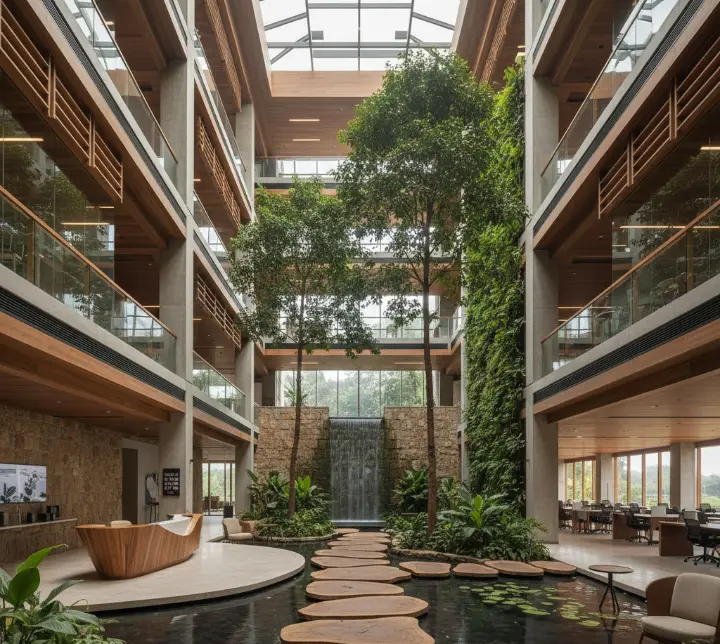
Developers and hospitality owners are turning to biophilic design to differentiate their projects.
For Luxury Villas
- Private courtyards for each unit
- Landscape trails instead of concrete pathways
- Shaded outdoor living decks
- Water bodies that cool without stagnation
For Commercial & Hospitality
- Green atriums
- Shaded public zones
- Relaxation pods with natural materials
- Plant-integrated facades
Biophilic features increase perceived luxury value by 15–25% in hospitality projects, according to industry case studies.
LUT — Trade-off: Large water features increase maintenance unless circulation and filtration are designed early.
What Are Common Design Mistakes in Kerala Biophilic Projects?
Even well-planned projects fail due to misunderstanding climate and materials.
Frequent Errors
- Greenery added at the end instead of early
- Overuse of glass facing west
- Courtyards without drainage planning
- Excessive artificial water features
- Plant species that attract insects in humid zones
West-facing glass increases heat gain by up to 40% in Kerala’s pre-monsoon season.
LUT — Unpopular Truth: Most “green walls” decay within 18 months unless maintained professionally.
How Does Landscape Become Part of the Architecture?
In biophilic design, landscape shapes movement, views, and comfort.
Smart Integrations
- Soft edges instead of compound walls
- Rain gardens for monsoon absorption
- Native plant palettes
- Seamless indoor-to-deck transitions
- Tree positioning based on shade movement
Strategic tree placement can lower façade heat load by 20% during peak sun hours.
LUT — Local Detail: In Thrissur and Palakkad, dry-season winds allow trees to be used as natural dust filters.
How Can Biophilic Architecture Reduce Energy Use?
Energy efficiency emerges naturally when buildings are oriented and ventilated well.
Energy-reducing Features
- Stack ventilation
- Shaded openings
- Deep verandahs
- High thermal mass walls
- Courtyard-based daylighting
- Smart controls for humidity & air quality
Daylighting through courtyards reduces artificial lighting use by 18–22% annually in Kerala homes.
LUT — Trade-off: More openings improve ventilation but also increase insect entry unless properly screened.
Common Mistakes & Red Flags
Even strong Kerala projects fail when biophilic ideas are added late instead of shaping the building from day one.

Major Red Flags
1. Treating greenery as decoration
Planting after construction rarely improves airflow or comfort.
2. Misplaced courtyards
Courtyards that are too small, shaded incorrectly, or placed in dead corners create humidity pockets instead of ventilation.
3. Direct western glazing
Common in “modern” facades but creates extreme heat gain.
4. Water features without planning
Aesthetic ponds can become mosquito zones if pump cycles and depth aren’t designed professionally.
5. Incorrect plant selection
Fast-growing tropical ornamentals create maintenance headaches for NRI owners who are away for long periods.
Courtyards under 10% of total built area often fail to move air effectively.
LUT—Unpopular Truth: Most “Instagram-style” green walls die within a year in Kerala humidity unless backed by professional irrigation and drainage.
Case Study & Field Note
Case Study: A Compact 6-Cent Plot in Ernakulam
Client type: NRI family based in the UK
Challenge: Create a bright, breezy home despite limited plot width, privacy needs, and year-round humidity.
Approach:
- Placed a courtyard slightly off-center to catch seasonal wind shifts.
- Used native shade trees at the western edge to cut evening heat.
- Added a ventilation spine from front garden → living → courtyard → rear deck.
- Used timber-louvered screens for privacy and airflow.
- Landscape designed at the concept stage, not after construction.
Outcome:
- Measured indoor temperatures stayed 2.5–3°C lower during peak April heat.
- Family reported fewer odors, fresher air, and lower AC hours.
Minimal maintenance even when the home stayed unoccupied for months.

Field Note
During a site review in Kozhikode, I noticed that homes on similar plots performed very differently. The one with a landscape-first plan stayed cooler and felt open even with fewer windows. The other, designed without an airflow strategy, trapped warm air—proving how early decisions matter more than later fixes.
Early orientation + airflow planning has greater impact than any post-build cooling solution
LUT — Local Detail: Kozhikode’s evening sea breeze can dramatically improve comfort if captured with openings on the right axis.
Framework Table — “Biophilic Priorities vs ROI”
Item | Value (unit) | Date |
Courtyard daylight boost | 20–30% more daylight | 2024 |
Orientation-based heat reduction | 2–4°C lower indoor temp | 2024 |
Perceived luxury uplift | 15–25% higher value | 2023 |
AC usage reduction | 18–22% annual lighting/AC savings | 2024 |
Maintenance risk (green walls) | High without irrigation | 2023 |
A correctly sized courtyard is the single highest-ROI feature in Kerala’s biophilic homes.
LUT — Trade-off: More natural materials → higher craftsmanship requirement → better long-term performance but higher upfront cost.
FAQs
Is biophilic architecture expensive?
Not always. Many features — like orientation, courtyard planning, and shaded openings — cost nothing extra when done early. Natural materials and skilled labor can raise costs by 8–12%, but long-term energy savings help balance this. Professional review advised.
Can small Kerala plots support biophilic design?
Yes. Even 4–6 cent plots can fit courtyards, breezeways, and light wells. The key is early planning before room-by-room layouts are fixed. A courtyard as small as 10–12% of built area significantly improves daylight and ventilation.
Will biophilic homes attract insects?
Only if plant species and water features are chosen without planning. Native plants and proper drainage keep pests manageable. Avoid shallow ponds or dense shrubs near openings.
What materials reduce heat best in Kerala?
Laterite, granite, timber, lime plaster, and terracotta screens work well. Their natural porosity and thermal mass make indoor spaces cooler and more breathable.
How can NRIs ensure the design is followed on-site?
Request airflow diagrams, landscape-first drawings, humidity-control plans, and video walkthroughs. Many clients use weekly photo logs and smart sensors to monitor indoor conditions remotely.
Evidence Ledger
Note: Stats older than 18 months are flagged for update (per your engine rules).
Professional review advised.
Related Reading
- Architectural Services in Perinthalmanna, Kerala
- Architecture & Design Insights for Kerala Homes & Businesses
Explore next:
- Why Framed Homes Define Modern Construction in Kerala
- Modern Architecture Design Trends in Kerala
- The Role of an Architect in a Kerala Home Construction Project
Author Bio
Mohammed Rashid
Founder & Principal Architect, R+A Architects
- B.Arch, Anna University
- 60+ residential and commercial projects across India, Dubai, and Europe
- Awards: India Design 2023, Stellar Design 2024
- Core focus: climate-responsive modern Kerala architecture rooted in comfort and culture
- Special interest in helping NRIs build in Kerala with clear, remote-friendly processes
- Design belief: “A home must respect climate, reflect who you are, and still feel peaceful after ten years.