
Modern home design in Kerala is evolving into a more intelligent and climate-responsive form of architecture where environment, lifestyle, and construction technology work together to create comfortable and functional living spaces. Today, modern home design in Kerala is no longer limited to visual appearance or luxury trends — it focuses on how a home performs in Kerala’s tropical climate, including heat control, ventilation, humidity management, and heavy monsoon protection.
In Kerala, architecture has always been closely connected to nature. Traditional homes were designed with courtyards, sloped roofs, shaded verandas, and natural ventilation systems that kept interiors cool without depending heavily on artificial cooling. Modern home design in Kerala continues these climate-friendly principles but adapts them to smaller plots, urban living conditions, and contemporary family lifestyles.
Today’s homeowners expect more than just shelter. They want homes that are energy-efficient, easy to maintain, naturally well-lit, and flexible enough for changing needs such as work-from-home spaces, open living layouts, and multi-functional interiors. As a result, architects now focus on balancing aesthetics with long-term comfort and practicality.
Modern home design in Kerala prioritizes climate comfort, natural ventilation, and long-term functionality over excessive visual complexity.
CLIMATE-DRIVEN ARCHITECTURE IN KERALA
Modern Kerala home design is deeply influenced by the region’s tropical climate. Heavy rainfall, high humidity, and warm temperatures throughout the year require buildings to function like climate-controlled systems rather than static structures.
Because of this, every architectural decision — from roof angle to window placement — is influenced by weather conditions. Sloped roofs are widely used because they allow rainwater to drain quickly, preventing leakage and structural damage. Similarly, raised foundations help protect homes from flooding during monsoon seasons.
Ventilation is another critical factor. Homes are designed to allow air to move continuously through rooms, reducing humidity and preventing heat buildup.
Climate conditions influence more than half of all design decisions in Kerala residential architecture.
EVOLUTION FROM TRADITIONAL TO MODERN HOMES
Kerala’s housing style has undergone a major transformation over the last few decades. Traditional homes were large, courtyard-centered structures built for joint families. These homes were naturally cool and well-ventilated but required large land areas and high maintenance.
As urbanization increased, land availability decreased and family structures became smaller. This led to a shift toward compact housing models and multi-functional layouts.
Modern homes now replace courtyards with open living spaces and reduce unnecessary internal walls to save space. However, the core principle of climate adaptation remains unchanged.
The shift to modern Kerala homes is driven more by urban space constraints than by design preference.
CORE DESIGN PRINCIPLES
Modern Kerala architecture is built on a few strong design principles that ensure long-term comfort and functionality. The most important among them are airflow, lighting control, and thermal balance.
Airflow ensures that humidity does not accumulate inside the home. Lighting design ensures that natural daylight is used efficiently without overheating interiors. Thermal balance ensures that materials and structures reduce heat absorption during the day.
These principles work together to reduce dependency on artificial cooling systems and improve indoor comfort naturally.
A well-designed Kerala home reduces the need for artificial cooling by relying on passive design principles.
SPACE PLANNING AND FUNCTIONAL DESIGN
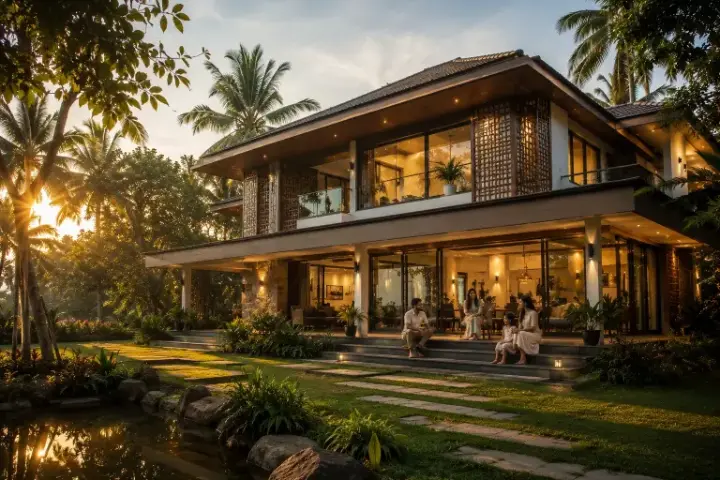
Space planning in modern Kerala homes focuses on maximizing usability rather than increasing size. Even small homes are designed to feel open and comfortable through smart layout planning.
Living, dining, and kitchen spaces are often combined into a single open zone, while bedrooms are kept private. This separation helps maintain both openness and privacy within limited space.
Designers also focus on multi-purpose areas where a single room can function as a study, guest room, or workspace depending on need.
Smart space planning can make compact homes feel significantly larger without increasing construction area.
MATERIALS AND CONSTRUCTION STRATEGY
Material selection plays a major role in how a home performs in Kerala’s humid environment. Concrete provides structural strength, while laterite stone helps regulate indoor temperature naturally. Clay tiles are commonly used for roofing due to their ability to reduce heat absorption.
Glass is widely used in modern homes to increase natural light, but it must be carefully positioned to avoid overheating. Wood is still used in interiors for aesthetic warmth but is limited due to moisture sensitivity.
The combination of traditional and modern materials creates homes that are both durable and visually balanced.
MATERIAL PERFORMANCE IN KERALA HOMES
Material | Primary Use | Climate Benefit | Maintenance Level | Year |
Laterite Stone | Walls | Natural cooling | Low | 2026 |
Clay Tiles | Roof | Heat reduction | Medium | 2026 |
Concrete | Structure | High durability | Low | 2026 |
Glass | Lighting | Natural daylight | High if unshaded | 2026 |
Wood | Interiors | Aesthetic + insulation | Medium–High | 2026 |
Material choice directly impacts indoor thermal comfort in tropical Kerala homes.
ROOF DESIGN AND RAIN MANAGEMENT
Roof design is one of the most critical elements in Kerala architecture because of intense monsoon rainfall. Sloped roofs are preferred because they allow water to flow off quickly, reducing leakage risk.
Modern designs often combine traditional roof slopes with reinforced concrete structures for durability. Proper drainage systems are also integrated to ensure water does not accumulate on rooftops or around foundations.
Poor roof planning is one of the most common causes of long-term structural issues in Kerala homes.
Roof design quality has a direct impact on long-term structural durability in Kerala homes.
VENTILATION AND AIRFLOW
Ventilation is essential in Kerala home design because of high humidity and warm weather. Good airflow keeps homes cool, dry, and comfortable without heavy use of AC.
Modern homes use cross-ventilation by placing windows on opposite sides to allow wind flow. High ceilings help hot air rise, making rooms feel cooler. Courtyards and open spaces also improve natural airflow.
Vent blocks and strategic window placement allow air movement while maintaining privacy. Proper planning of wind direction improves comfort significantly.
Proper ventilation design can naturally reduce indoor heat and humidity in Kerala homes.
Key points:
- Cross ventilation improves airflow
- High ceilings reduce heat buildup
- Courtyards support natural cooling
- Window placement affects comfort
- Poor ventilation leads to humidity issues
LIGHTING AND INTERIOR ENVIRONMENT
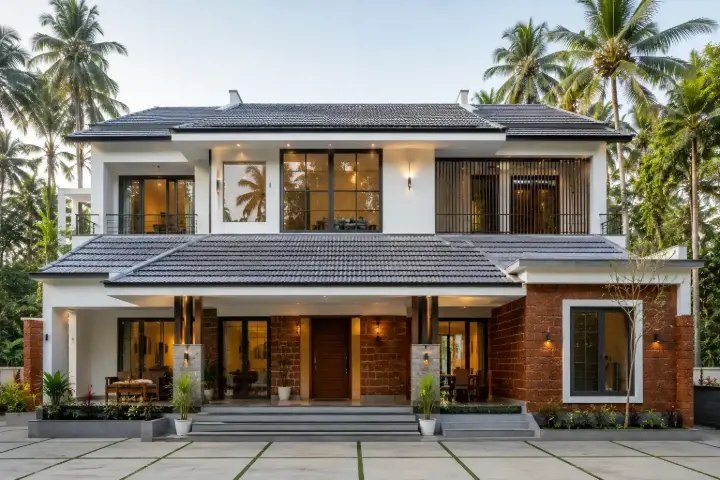
Natural lighting is a key part of modern Kerala homes. Large windows and open layouts are used to bring in daylight, reducing electricity usage during daytime hours.
However, lighting must be balanced carefully. Excess sunlight can increase indoor temperature, so shading systems like curtains, louvers, or extended roof edges are often used.
Interior colors are also chosen to reflect light and create a brighter indoor environment.
Controlled natural lighting improves energy efficiency while maintaining indoor comfort.
SUSTAINABLE HOME DESIGN
Sustainability is becoming an essential part of modern Kerala architecture. Homes are now designed to reduce environmental impact while improving long-term cost efficiency.
Rainwater harvesting systems are widely used due to Kerala’s high rainfall. Solar energy systems are also increasingly common in new homes. Passive cooling methods, such as shaded walls and natural ventilation, reduce the need for air conditioning.
Sustainable design in Kerala homes is driven by both environmental needs and cost savings.
COMMON DESIGN MISTAKES
Many issues in modern Kerala homes are not due to poor construction but due to poor design planning. Overuse of glass without shading is one of the most common problems, leading to heat buildup inside homes.
Another issue is ignoring wind direction during layout planning, which reduces airflow efficiency. Improper roof slope design and lack of drainage planning can also lead to long-term maintenance problems.
TRADITIONAL VS MODERN HOMES
Feature | Traditional Homes | Modern Homes | Year |
Layout | Courtyard-based | Open-plan | 2026 |
Cooling | Natural airflow | Mixed | 2026 |
Space Use | Large land | Compact | 2026 |
Maintenance | High | Moderate | 2026 |
Materials | Natural | Mixed | 2026 |
Most residential comfort issues in Kerala homes originate from design errors, not material quality.
COST AND VALUE PLANNING
Cost planning in Kerala home design is not only about construction expenses but also about long-term maintenance. A well-designed home may cost slightly more initially but significantly reduces repair and energy costs over time.
Simple design decisions like ventilation planning, material selection, and roof design can influence lifetime costs more than luxury finishes.
Good architectural planning reduces long-term maintenance costs more than initial material savings.
FUTURE OF HOME DESIGN IN KERALA
The future of Kerala home design will combine traditional climate knowledge with modern technology. Smart ventilation systems, solar integration, and modular construction methods are expected to become more common.
However, even with technological advancement, the core principles of natural cooling, ventilation, and rainfall adaptation will remain unchanged.
Future Kerala homes will be technology-assisted but still climate-driven at their core.
FREQUENTLY ASKED QUESTIONS
What is modern home design in Kerala?
Modern home design in Kerala is a blend of traditional architectural principles and modern construction methods. It focuses on climate comfort, space efficiency, and simple living rather than heavy decoration.
Why is ventilation important in Kerala homes?
Kerala has high humidity and warm weather, so proper ventilation helps remove moisture and keeps indoor spaces cooler and healthier without relying heavily on air conditioning.
Which roof type is best for Kerala homes?
Sloped roofs are considered the best because they allow fast rainwater drainage during monsoon seasons and reduce leakage or structural damage.
Are modern Kerala homes expensive to build?
Cost depends on design choices, materials, and layout complexity. Simple designs with good planning are more cost-efficient in the long run than heavily decorative homes.
Can traditional design elements still be used in modern homes?
Yes, many modern homes still use courtyards, wooden accents, and sloped roofs because they improve airflow, cooling, and overall comfort.
What is the biggest mistake in Kerala home design?
The most common mistake is ignoring climate factors like ventilation and roof design, which leads to humidity, heat issues, and long-term maintenance problems.
Modern home design in Kerala represents a thoughtful balance between tradition and innovation. It is shaped by climate, influenced by lifestyle changes, and improved by modern materials and construction methods. The most successful homes are not the most expensive or visually complex, but those that perform well in real living conditions — staying cool, dry, and comfortable throughout the year.
The best Kerala homes are designed for climate performance first, aesthetics second.
About the Author
Mohammed Rashid
Founder & Principal Architect, R+A Architects
Mohammed Rashid, Founder & Principal Architect at R+A Architects, holds a B.Arch from Anna University. With 60+ projects across India, Dubai, and Europe, and awards including India Design 2023 and Stellar Design 2024, he champions modern Kerala architecture rooted in climate, comfort, and culture.
Related Reading
- Architectural Services in Perinthalmanna, Kerala
- Architecture & Design Insights for Kerala Homes & Businesses
Explore next:
- How a Good Architect Can Simplify the Complexities of Building Permits
- Kerala Coastal Zone Management Authority.
- Build Your Luxury NRI Villa in Kerala with Complete Design + PMC Support