
A home becomes meaningful when its architecture connects people to light, air, and nature. At the Shabeer Ali Residence, designed by R+A Architects, that connection takes form in the central patio — a tranquil void that breathes life into every space around it.
In Kerala’s humid tropical climate, homes have always needed a breathing core — a place for air and light to circulate freely. The Shabeer Ali Residence reinterprets this age-old wisdom through a modern lens.
Here, the patio is not a decorative courtyard; it’s the home’s emotional and climatic anchor. It’s where daylight softens walls, where families pause, and where nature enters with grace.
Inspired by traditional nalukettu homes, this design blends vernacular comfort with contemporary living ideals.
The Role of Courtyards in Kerala Homes
Historically, the courtyard — or mutram — was central to Kerala homes, shaping family interactions and controlling climate.
Today, with shrinking plots and dense neighborhoods, the challenge lies in bringing that essence into compact, urban settings. The Shabeer Ali Residence achieves this through a courtyard-patio hybrid, combining traditional planning with minimal modern detailing.
Local Observation: Across Kochi and Calicut, modern villas are rediscovering open courtyards as tools for cooling, lighting, and emotional balance.
Courtyard design is re-emerging in Kerala as both an environmental and emotional necessity.
A Central Pause Between Functions
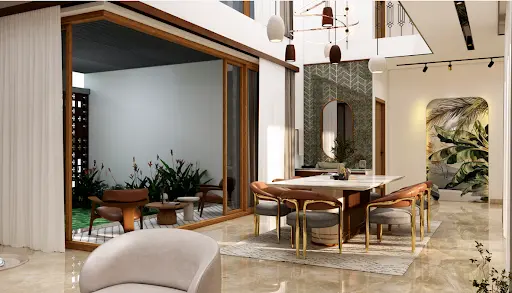
Strategically positioned between the dining area and kitchen, the patio becomes a moment of calm amid the home’s daily flow.
It bridges the social and private zones, creating visual and spatial connections that extend toward the dining, family living, and bedroom passage.
This intentional placement transforms the patio into a transitional courtyard — subtly guiding movement while maintaining openness and intimacy.
Our architectural services in Kerala ensure such design moments are purposeful — balancing light, circulation, and connection in every home layout.
Claim: Central courtyards improve natural ventilation and family interaction while lowering indoor temperature by up to 3°C.
(Source: IMD Climate Data)
Why Patios Matter in Contemporary Homes
Across cultures and climates, patios and courtyards have long served as the social and climatic heart of a home.
Today, as homes evolve, these open spaces are making a comeback — offering sustainable, emotionally rich alternatives to sealed interiors.
A well-placed patio provides natural light, ventilation, visual relief, and mental calm, redefining how we perceive comfort and openness.
For modern Indian homes, they represent a bridge between tradition and innovation — a way to embrace biophilic design while maintaining spatial luxury.
Patios are central to our sustainable architecture approaches, where design adapts to Kerala’s humid climate without relying heavily on mechanical cooling.
Explore more design insights for Kerala homes and businesses to see how courtyards and verandas continue to redefine tropical comfort.
Claim: Courtyard-based design reduces dependence on air-conditioning by nearly 30%.
(Source: World Green Building Council)
Designing for Connection and Calm
The patio’s design encourages stillness and movement simultaneously. Sliding glass panels open to dissolve the line between inside and out. The light shifts gently throughout the day — playful, soft, alive.
Design Principle: Openness within enclosure.
This philosophy guides every detail — proportion, texture, and transition.
| Design Element | Function | Emotional Impact |
| Open-to-sky void | Passive cooling | Breathing space |
| Green planters | Visual relief | Calm, biophilic connection |
| Reflective flooring | Light diffusion | Expansive feel |
| Glass boundaries | Transparency | Spatial fluidity |
Connection is achieved through proportion, texture, and controlled openness.
Material Palette and Mood
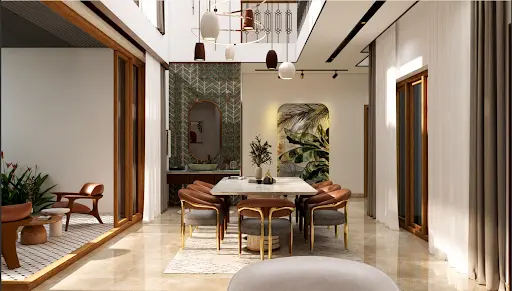
Every surface around the patio speaks the same language — earthy, warm, tactile.
Materials Used:
- Terracotta-textured tiles for flooring.
- Wooden door and window frames.
- Brass accents for subtle glow.
- Lush greenery in planters for depth and freshness.
The neutral palette allows light and shadow to take the lead, turning each moment into a changing artwork.
Our luxury home interiors in Kerala pair natural finishes with thoughtful detailing, transforming homes into calm, sensory environments.
Thoughtful material harmony amplifies emotional comfort.
Natural Ventilation and Light Play
The open-to-sky design ensures constant air exchange. Sunlight filters through perforated metal screens (jali), creating a dynamic interplay of shadow and glow.
This reduces dependence on artificial lighting and air conditioning — enhancing energy efficiency.
As Dezeen notes, open-courtyard homes encourage sensory engagement through light and climate — qualities missing in closed designs.
Claim: Passive cooling and daylight design make patios inherently sustainable. (Anchor: #light)
Evolving Ambience Through the Day
The patio transforms through the day:
- Morning: Crisp sunlight and freshness.
- Afternoon: Filtered light, gentle warmth.
- Evening: Golden glow, reflections, and calm.
At night, soft wall lighting and reflections from adjoining interiors give it a meditative quality — a sanctuary within the home.
A well-lit patio becomes an emotional anchor that changes character with time.
Framework: Light–Ventilation–Emotion Balance
| Principle | Spatial Strategy | Result |
| Light | Open-to-sky void + reflective surfaces | Natural illumination, energy savings |
| Ventilation | Cross-drafting via sliding panels | Comfortable airflow |
| Emotion | Human-scale proportion + texture | Calmness, connection |
This framework illustrates how design decisions translate into emotional outcomes.
Balanced design creates both environmental efficiency and emotional resonance.
Case Study: The Shabeer Ali Residence Patio
Client: Mr. Shabeer Ali & Family
Location: Calicut, Kerala
Type: Contemporary Residence with Central Patio
Completion: 2024
“Our goal was to design a home that felt open yet private, where every space connects back to nature. The patio became the heart of that experience.” — Mohammed Rashid, Founder, R+A Architects.
Results:
- Temperature reduced by 3–4°C indoors.
- Natural daylight across 70% of interiors.
- Improved family interaction through visual openness.
Featured in McKinsey Design Report for climate-responsive design strategies.
Integrating light and life enhances both comfort and sustainability.
Actionable Takeaways for Homeowners
For Kerala Homeowners:
✅ Prioritize courtyards or patios in early design planning.
✅ Choose breathable materials like terracotta or bamboo composites.
✅ Ensure cross-ventilation in dining and living areas.
For NRI Clients:
✅ Use virtual walkthroughs to visualize light and air flow.
✅ Ask your architect for a climatic performance study.
✅ Connect with Contact Our Team for personalized patio concepts.
Integrating a patio early ensures harmony between architecture and environment.
FAQs
Q1: Why are patios ideal for Kerala’s climate?
They promote natural ventilation and reduce indoor humidity through passive cooling.
Q2: Can patios work on small plots?
Yes, with smart planning, even compact homes can include light courts or corner patios.
Q3: Are patios high maintenance?
Not necessarily — using weather-resistant materials minimizes upkeep.
Q4: How can NRIs oversee such designs remotely?
Through digital coordination, BIM models, and photo updates managed by R+A Architects.
Q5: How do I begin planning one?
Book a consultation with Contact Our Team to start a feasibility and design discussion.
Author Bio
Mohammed Rashid, Founder & Principal Architect, R+A Architects
B.Arch (Anna University). With 60+ projects across India, Dubai, and Europe, he’s recognized by India Design Awards 2023 and Stellar Design Awards 2024 for redefining luxurious interiors in Kerala through elegant, functional design.