
Contemporary house design Kerala is not about creating a modern-looking front elevation alone. It is about designing a home that feels open, handles local weather well, and supports the way Kerala families live every day.
Many homeowners now prefer clean lines, large openings, open living areas, premium finishes, and simple elevations. But in Kerala, these choices need careful judgment. A large glass wall may look elegant in a 3D render, yet become unusable if it faces harsh afternoon sun or a neighbouring window. A flat roof may look sleek, but poor slope and waterproofing can turn it into a recurring monsoon issue.
A good contemporary Kerala home blends simplicity, elegance, and practical living with the state’s tropical setting. It uses clean forms, natural light, cross-breeze planning, shaded openings, courtyards, balconies, and durable materials to create a modern home that remains comfortable after the first year, not just attractive on handover day.
Why Contemporary House Design Matters in Kerala
Contemporary Kerala homes work best when modern style is shaped by monsoon behaviour, humidity, privacy, and daily family routines.
Kerala is a rewarding but demanding place to build. A house here must respond to heavy seasonal rain, warm air, compact plots, changing family structures, road-facing privacy concerns, and rising expectations for comfort.
This is one reason contemporary design has become popular across the state. It gives homeowners a refined, premium look without depending on heavy ornamentation. It also allows better space planning, larger openings, open living-dining areas, balconies, courtyards, and flexible rooms that can adapt over time.
The value of contemporary design, however, is not in the elevation alone. It is in how the home behaves after the family moves in.
A well-planned Kerala home should answer practical questions:
- Can the living room receive daylight without overheating?
- Can windows be useful during light showers?
- Can the family enjoy openness without feeling exposed?
- Can terraces, balconies, and roof edges drain cleanly during monsoon?
- Can the exterior age well without constant repair?
- Can the home look modern while still learning from local building wisdom?
This is where contemporary house design in Kerala becomes more than a style. It becomes a disciplined approach to planning, comfort, and long-term value.
Internal link opportunity: Link naturally to a guide on Kerala home planning or house planning mistakes from this section.
What Is Contemporary House Design in Kerala?
Contemporary house design in Kerala combines clean architecture with site-aware planning, not just a modern-looking front elevation.
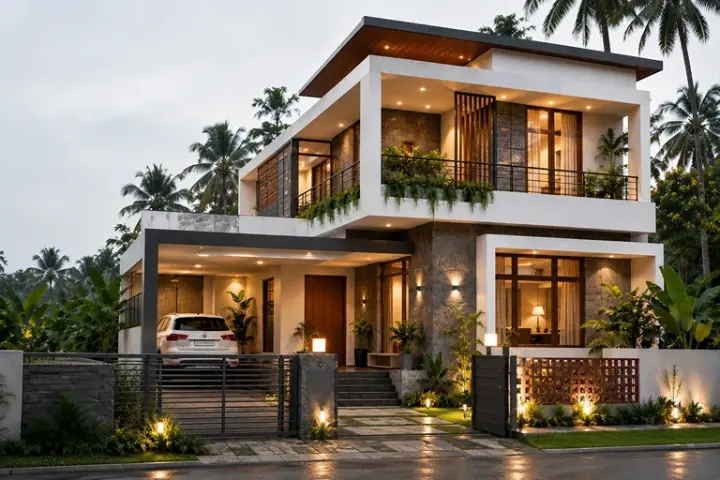
Contemporary house design in Kerala is a modern architectural approach built around simple forms, open interiors, natural light, smooth indoor-outdoor connections, and everyday comfort. It avoids heavy decorative work and gives more importance to proportion, material quality, airflow, shade, and intelligent space use.
In Kerala, this style should not be copied directly from global design references. A home in Kochi, Thrissur, Calicut, Kottayam, or Trivandrum has different demands from a house in a dry or cold region. Site width, road noise, neighbouring buildings, afternoon sun, drainage, and local approval rules all influence the final design.
A good contemporary Kerala home may include:
- A shaded sit-out instead of a fully exposed entrance.
- Recessed windows instead of glass pushed to the outer edge.
- A balcony that protects the lower wall and creates depth.
- A compact courtyard or light well for dense plots.
- A clean roofline with planned water movement.
- A warm material palette instead of too many cladding finishes.
- Landscape edges that soften the building and improve privacy.
On a compact Kochi plot, for example, the most powerful design move may not be a bold façade. It may be a narrow light court beside the stair, a screened balcony facing the road, and a well-shaded living room that stays pleasant through the day.
RplusA Architects can use this kind of design lens to create homes that feel modern while still respecting Kerala’s climate, plot realities, and family lifestyle.
Common Features of Contemporary Kerala Homes
Feature | Purpose in Kerala homes | Practical benefit |
Recessed large windows | Bring daylight while reducing direct sun and rain exposure | Makes rooms brighter without making them too hot |
Shaded balconies | Protect walls and openings from rain and sun | Keeps outdoor areas usable for more months |
Open living-dining layout | Supports modern family interaction | Makes compact homes feel larger |
Courtyards or light wells | Bring air and light into the center of the home | Helps narrow Kerala plots feel open |
Flat and sloped roof combinations | Balance modern appearance with rainfall response | Gives a clean look without ignoring monsoon needs |
Minimal elevation detailing | Reduces visual clutter | Makes the home easier to maintain |
Tropical landscaping | Adds shade, privacy, and softness | Improves comfort and street appeal |
Why Kerala Homeowners Prefer Contemporary Design
Contemporary homes are popular in Kerala because they offer a cleaner look, flexible layouts, and better use of compact plots.
Kerala families increasingly want homes that feel lighter, more open, and easier to use. Many older house styles had more visual weight, enclosed rooms, and decorative detailing. Contemporary homes offer a simpler and more flexible alternative.
The appeal is practical as much as visual. A well-designed contemporary home can make a small plot feel generous. It can connect the living, dining, kitchen, stair, and courtyard in a way that improves light and movement. It can also create a premium appearance with fewer materials when the proportions are handled well.
This matters in many Kerala towns where plots are narrow, roads are busy, and neighbouring homes sit close on both sides. In such settings, design quality comes from planning, not decoration. A screened balcony, a carefully placed window, or a small garden strip can change how the entire home feels.
Myth vs Fact
- Myth: Contemporary homes are always expensive.
Fact: They become expensive when the form, glazing, finishes, and structure are overcomplicated. - Myth: A contemporary home must have a flat roof.
Fact: A clean sloped roof or mixed roof can look contemporary and perform better in heavy rainfall. - Myth: More glass means better design.
Fact: In Kerala, unprotected glass can create heat gain, glare, and exposure. - Myth: Minimal design means plain design.
Fact: Good minimal design depends on proportion, shadow, texture, and detail. - Myth: Traditional Kerala ideas cannot fit a modern home.
Fact: Courtyards, verandahs, deep shade, and sloped roofs can be reinterpreted in a contemporary way.
How Kerala’s Climate Should Shape Contemporary Homes
In Kerala, the best contemporary homes are designed from site behaviour first and elevation style second.
Kerala’s warm-humid setting has a direct effect on how a home should be planned. A house that ignores sun path, seasonal rain, and airflow may look beautiful at handover but feel uncomfortable or costly later.
A climate-responsive contemporary home uses shade as part of the architecture. This may come from roof projections, balconies, pergolas, vertical fins, recessed openings, trees, or screened sit-outs. These elements are not just decorative; they create shadow, depth, and comfort.
Air movement also needs to be planned, not assumed. An open-plan room does not automatically breathe well. Windows must be placed where air can enter and exit. Stair courts, double-height pockets, courtyards, and opposite openings can help the home feel lighter without depending only on mechanical cooling.
Rain detailing deserves equal attention. Terrace slopes, balcony outlets, waterproofing layers, drip grooves, sill details, and wall protection all affect how the house ages. In many Kerala homes, the difference between a premium building and a problematic one is hidden in these details.
A useful design rule is simple: every contemporary feature should answer a site question.
- Large window: where is the shade?
- Balcony: where does water move?
- Flat roof: how is drainage handled?
- Courtyard: how is heavy rain managed?
- Exterior cladding: how will it age in humidity?
- Landscape: can it soften heat, views, and noise?
Contemporary vs Traditional Kerala House Design
Contemporary Kerala homes should not reject tradition; they should reinterpret the parts that still solve comfort and durability problems.
Traditional Kerala homes were not just visually rich. Many of their features had a clear purpose. Sloped roofs handled heavy rain. Verandahs gave shade. Courtyards brought light into deep plans. Timber details added warmth. Raised plinths helped protect the house from ground moisture.
Contemporary design uses a different visual language. It is cleaner, simpler, and more geometric. It may use concrete, glass, steel, natural stone, textured plaster, aluminium, and engineered wood. But the smartest contemporary homes still borrow wisdom from older Kerala houses.
For example, a traditional verandah can become a modern shaded sit-out. A nadumuttam can become a compact internal court. A sloped tiled roof can become a clean roof accent. A timber-heavy look can become warm wood-textured screens, ceilings, or entrance details.
The result does not need to look old. It simply needs to carry forward what worked.
Contemporary vs Traditional Kerala House Design
Design aspect | Traditional Kerala home | Contemporary Kerala home | Best practical approach |
Roof | Steep sloped roof | Flat, sloped, or mixed roof | Use rain-safe detailing with a clean modern profile |
Openings | Smaller shaded windows | Larger windows and glass panels | Add shading, recesses, and privacy screens |
Layout | Courtyard-centered and room-based | Open-plan and flexible | Use light wells or semi-open courts where useful |
Materials | Timber, clay tile, laterite | Concrete, glass, steel, stone, textured finishes | Mix durable modern materials with local warmth |
Style | Ornamental and regional | Minimal and geometric | Keep the design simple but climate-aware |
What Makes a Contemporary Kerala Home Feel Unique
A unique contemporary Kerala home comes from site response, not from adding more elevation materials.
Many modern homes begin to look similar because they follow the same visual formula: white box, dark cladding, glass railing, vertical fins, and a flat roof. It may look current for a few years, but it can quickly become generic.
A unique contemporary Kerala home starts with the site.
A corner plot may need a stronger street-facing composition. A narrow urban plot may need a courtyard, skylight, or tall internal volume to avoid a tunnel-like feel. A west-facing home may need deeper overhangs and filtered openings. A road-facing house may need layered privacy through screens, planting, and setback planning. A plot near a waterbody may need more careful material selection. A hillside site may need stepped planning instead of forcing the house into a flat arrangement.
This is where design becomes personal.
A home for a young family may need open common areas, visible play zones, and future expansion. A home for parents and adult children may need privacy between floors. A retirement home may need fewer level changes, shaded outdoor seating, and easy upkeep. A villa used only during holidays may need security, passive cooling, and finishes that tolerate being closed for long periods.
The unpopular truth is that a home becomes unique when it solves the owner’s real life, not when it copies a dramatic elevation.
Best Materials for Contemporary House Design in Kerala
In Kerala, material selection should be based on rain exposure, humidity, cleaning, heat, and long-term ageing.
Kerala’s setting is not gentle on buildings. Exterior walls face rain splash, moisture, algae, dust, heat, and frequent repainting pressure. This makes material selection a practical design decision, not just an aesthetic one.
Good material choices include:
- Textured exterior paint: Works well for clean contemporary elevations, especially when paired with good surface preparation and weather-resistant coatings.
- Natural stone: Adds depth and local character, but should be used with restraint so the elevation does not feel heavy.
- Laterite accents: Can bring a Kerala-specific texture when detailed in a modern, controlled way.
- Clay roof tiles: Useful for sloped roof portions and warm regional character.
- Aluminium windows: Suitable for larger openings, provided sealing, drainage, and hardware quality are not compromised.
- WPC or engineered wood: Helpful for screens and ceiling accents where natural wood maintenance may be difficult.
- Anti-skid outdoor tiles: Important for sit-outs, balconies, steps, and terrace areas.
- Metal screens or pergolas: Useful for filtered light and elevation depth, but require proper anti-corrosion treatment.
The best contemporary homes usually use fewer materials, not more. A calm mix of paint, one strong texture, one warm accent, and landscape often looks richer than a façade filled with competing finishes.
A practical field insight: in closely packed neighbourhoods, material restraint helps the home feel calm from the street. Too many finishes can make even an expensive house feel busy.
Cost and Budget Planning for Contemporary Kerala Homes
Contemporary homes stay budget-friendly when the structure is simple and premium materials are used only where they matter.
Contemporary design can be cost-conscious, but it can also become expensive if not controlled early. Costs usually rise because of complex forms, long cantilevers, large custom windows, imported finishes, excessive cladding, and complicated roof details.
The best way to control cost is to make architectural decisions before the design becomes too detailed.
Keep the building shape clear. Use premium materials only on key areas such as the entrance wall, balcony face, or sit-out. Avoid using five or six exterior finishes just to make the elevation look rich. Let the design quality come from proportion, light, shadow, and clean detailing.
Spend first on things that are hard to fix later:
- Structural design
- Waterproofing
- Roof and terrace drainage
- Window quality
- Electrical planning
- Plumbing routes
- Air movement
- Storage
- Service access
Spend second on things that can be upgraded later:
- Decorative lighting
- Loose furniture
- Landscape layers
- Wall textures
- Premium fixtures
- Custom décor
A practical Kerala home should not exhaust the budget on elevation alone. The house still needs good interiors, storage, drainage, compound planning, and long-term support.
Approvals and Site Checks Before Construction
A contemporary design should be finalized only after checking the plot, road width, setbacks, drainage, and local approval rules.
Before building a contemporary home in Kerala, homeowners should check the technical and legal basics. This step may not feel creative, but it protects the project from redesign, delay, and avoidable cost.
Important checks include:
- Plot size and shape
- Road width
- Front, rear, and side setbacks
- Building coverage limits
- Height restrictions, where applicable
- Parking requirements
- Site drainage direction
- Soil and waterlogging risk
- Septic tank or sewage connection rules
- Coastal, wetland, hill, or special zone restrictions
- Local municipality, corporation, or panchayat requirements
Professional review advised before buying land, finalizing drawings, or starting construction.
A good architect should not treat approval drawings as paperwork only. Approval constraints should shape the design from the beginning. This helps avoid awkward changes after the family has already fallen in love with a concept.
Common Mistakes in Contemporary House Design Kerala
Most contemporary home mistakes happen when the elevation is designed before site, layout, services, and long-term use are solved.
A modern home can fail quietly. It may photograph well, but feel hot, exposed, dark in the wrong places, difficult to clean, or awkward to live in. These are the mistakes Kerala homeowners should avoid.
1. Copying a foreign-style glass elevation
A glass-heavy home may look premium, but in Kerala it can create heat gain, glare, exposure, and higher cooling needs.
2. Treating flat roofs casually
Flat roofs can work, but they need careful slope, waterproofing, outlet placement, drip edges, and maintenance access.
3. Using too many elevation materials
Too much cladding, texture, paint colour, railing detail, and lighting can make the house look busy. Simpler compositions often age better.
4. Ignoring rain splash zones
Low walls, balcony edges, exposed openings, terrace corners, and compound edges need protection from staining and water marks.
5. Forgetting service areas
Laundry, drying space, AC outdoor units, plumbing shafts, electrical panels, and storage should be planned early, not hidden later.
6. Designing windows only for appearance
Windows must support light, air movement, privacy, and shade. A window that stays covered all day is not doing its job.
7. Making the home too open for the family’s lifestyle
Open plans are useful, but Kerala families may still need privacy between guests, kitchen, prayer space, study, and bedrooms.
8. Not planning for ageing users
Steps, slippery outdoor tiles, poor lighting, and distant bedrooms can become problems for elderly family members.
The Kerala Home That Works Better After Reducing Design Clutter
Many Kerala homes become more elegant when unnecessary cladding, exposed glass, and decorative features are reduced.
A common homeowner brief is: “We want the house to look rich, but not too costly or hard to maintain.” Often, the first instinct is to add more: stone, wood texture, glass, grooves, metal, lighting, and multiple paint colours.
In practice, the better answer is often subtraction.
For a typical 8–12 cent Kerala plot, the design can improve through a cleaner elevation, deeper shade, fewer materials, and better planting. A shaded car porch, recessed sit-out, open living-dining space, stair skylight, compact courtyard, and private bedroom placement can make the home feel premium without visual noise.
In many Kerala homes, the elevation improves when material clutter is reduced rather than increased. The result feels calmer, more timeless, and easier to care for.
This is a strong direction for contemporary house design in Kerala: modern, but not loud; elegant, but not fragile; simple, but not plain.
Contemporary Kerala Home Design Checklist
Claim: A clear checklist helps homeowners judge whether a contemporary home is beautiful, buildable, comfortable, and site-ready.
Anchor: #contemporary-kerala-home-design-checklist
Checklist 1: Before Design Starts
Do this now:
- Step 1: Confirm plot size, shape, road width, and location category.
- Step 2: Note the plot direction and strongest sun exposure.
- Step 3: Decide the total budget, including interiors, compound wall, landscape, and approvals.
- Step 4: List family members, daily routines, guest needs, storage needs, and future expansion plans.
- Step 5: Mark lifestyle needs such as home office, prayer room, elderly-friendly room, open kitchen, or separate work kitchen.
- Step 6: Collect reference images, but also write what you like about each image.
- Step 7: Tell the architect what you do not want, such as too much glass, high-upkeep finishes, or dark interiors.
Proof you keep: Site photos, plot document copy, budget note, family requirement list, reference image folder, date.
Checklist 2: Before Final Approval Drawings
Do this now:
- Step 1: Check setbacks, coverage, height, and parking requirements.
- Step 2: Review window placement for daylight, airflow, visual comfort, and rain protection.
- Step 3: Confirm roof, balcony, terrace, and site drainage.
- Step 4: Mark AC outdoor units, plumbing shafts, electrical panels, laundry, drying area, and storage.
- Step 5: Review exterior materials for humidity, staining, cleaning, and repainting.
- Step 6: Check elderly access, stair safety, outdoor tile grip, and night lighting.
- Step 7: Ask whether the design will still look good if one premium material is removed.
Proof you keep: Final drawing set, approval checklist, drainage plan, service layout, material list, date.
Simple Framework: The 4C Method
Use this before approving the design:
- Climate: Will this home stay comfortable in May and during monsoon?
- Comfort: Will the family use the spaces easily every day?
- Cost: Is the design affordable after construction, including upkeep?
- Character: Does the home feel modern while still belonging to Kerala?
FAQs
Contemporary Kerala homes should be simple, shaded, well-ventilated, private where needed, and planned around real family life.
1. What is contemporary house design in Kerala?
Contemporary house design in Kerala is a modern home style that uses clean forms, open layouts, natural light, practical materials, and site-aware planning. It focuses on comfort and simplicity rather than heavy decoration.
2. Is contemporary design suitable for Kerala’s climate?
Yes, but it must be designed carefully. A contemporary Kerala home should include shade, air movement, rain protection, durable finishes, and proper drainage. Without these, the home may look modern but feel uncomfortable or become difficult to care for.
3. Can a contemporary Kerala house have a sloped roof?
Yes. A sloped roof can look contemporary when it is designed with clean lines. In Kerala, sloped or mixed roof forms can be useful because they respond well to heavy rainfall.
4. Are contemporary homes expensive to build?
They do not have to be expensive. Cost increases when the design uses large custom glass panels, complex structural forms, too many materials, or premium finishes everywhere. A simple contemporary home can be elegant and budget-conscious.
5. What colours work best for contemporary homes in Kerala?
White, off-white, beige, grey, earthy tones, and muted warm shades work well. These can be paired with wood textures, stone, black metal accents, clay tile, or tropical greenery.
6. How can a contemporary home stay cool naturally?
Use shaded openings, cross-breeze planning, courtyards, light wells, roof insulation, landscape shade, and reduced direct west-facing glass. These design choices can improve comfort before depending heavily on air conditioning.
The best contemporary Kerala homes balance modern style with shade, airflow, rain protection, privacy, and long-term value.
Contemporary house design in Kerala is not only about clean lines, flat roofs, large windows, or premium finishes. It is about creating a home that feels modern while belonging naturally to its site, its climate, and the family that lives inside it.
A well-designed contemporary Kerala home should be bright without feeling harsh, open without feeling exposed, stylish without becoming difficult to maintain, and simple without becoming generic. Its beauty should come from proportion, light, shadow, material restraint, and thoughtful planning.
For homeowners, the best starting point is not an elevation image. It is the site, the sun direction, the rainfall exposure, the family routine, the budget, and the long-term care plan. Once these are understood, contemporary design can create more than a good-looking house. It can create a calm, practical, future-ready home that feels right in Kerala.
About the Author
Mohammed Rashid
Founder & Principal Architect, R+A Architects
Mohammed Rashid, Founder & Principal Architect at R+A Architects, holds a B.Arch from Anna University. With 60+ projects across India, Dubai, and Europe, and awards including India Design 2023 and Stellar Design 2024, he champions modern Kerala architecture rooted in climate, comfort, and culture.
Related Reading
- Architectural Services in Perinthalmanna, Kerala
- Architecture & Design Insights for Kerala Homes & Businesses
Explore next:
- How a Good Architect Can Simplify the Complexities of Building Permits
- Kerala Coastal Zone Management Authority.
- Build Your Luxury NRI Villa in Kerala with Complete Design + PMC Support