
For many Malayali families living in London, Birmingham or Manchester, building a home in Kerala is about staying connected to their roots. But a Kerala holiday home for UK NRIs has one unusual requirement: it may remain empty for most of the year.
A house designed for everyday living receives regular attention. A holiday home might stay locked throughout the monsoon, with nobody noticing a minor leak, damp cupboard or plumbing problem.
This makes the design approach different.
The goal is not simply to create a beautiful house. It is to build a home that remains practical to maintain while the family is abroad and comfortable whenever they return.
Here are the design decisions that deserve attention before construction begins.
Design for the Months the House Stays Empty
The time a holiday home remains unoccupied should influence its layout, building services and maintenance plan.
Most families begin planning with bedrooms, living areas, kitchens and exterior elevations. UK-based NRIs should also think about what happens after they leave.
Ask three questions:
- Can the house be inspected and maintained without opening every room?
- Can water and electrical systems be safely managed during long absences?
- How quickly can the home be prepared before the next family visit?
These questions affect everything from plumbing access to interior finishes.
An important design principle: A holiday home should have two operating modes—comfortable family living and safe, manageable vacancy.
Plan a Practical Layout Instead of Unused Luxury Spaces
Flexible spaces can offer greater long-term value than large rooms that remain unused for most of the year.
It is natural to imagine a spacious Kerala house with several guest bedrooms, a formal living room and a large upstairs lounge.
However, every extra room adds cleaning and upkeep requirements.
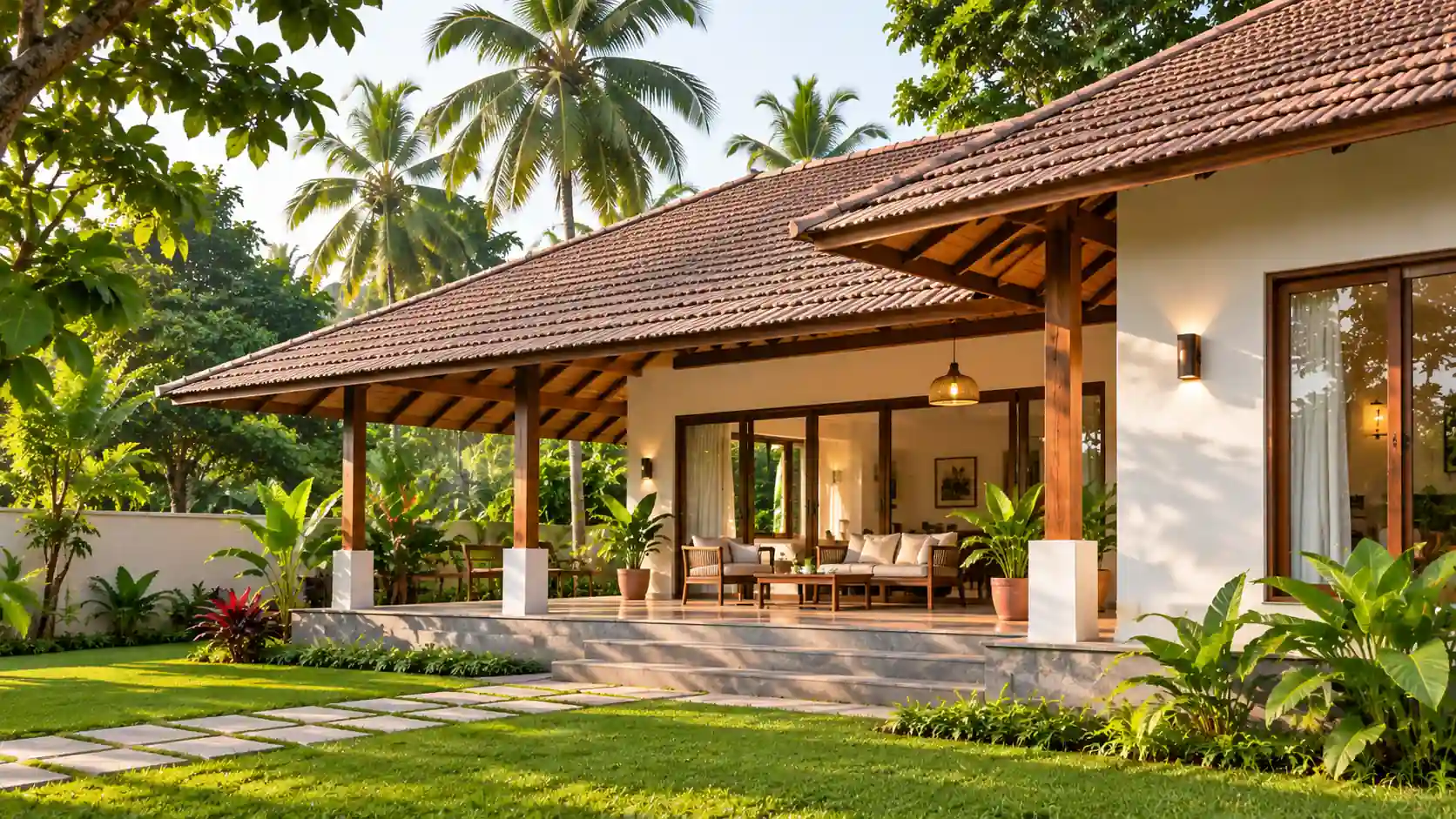
A practical alternative is to organise the home around a comfortable ground-floor living area, kitchen, main bedroom and shaded sit-out.
A flexible guest room can serve as a study or workspace between family gatherings.
If the family expects parents to stay in Kerala or plans to retire there later, a ground-floor bedroom and accessible bathroom can make the home more adaptable.
The objective is not to build the smallest possible house. It is to make every square foot useful.
Make Kerala's Monsoon a Priority From Day One
Rainwater drainage, waterproofing and site levels are critical when leaks may go unnoticed for weeks.
Kerala's climate makes rainfall protection one of the most important parts of holiday-home design.
A house in coastal Alappuzha may face different drainage conditions from one on higher ground in Wayanad or an inland plot near Perinthalmanna.
Before designing the roof, the architect should study how water moves across the site.
Important details include:
- Properly designed roof slopes and drainage outlets.
- Accessible rainwater gutters and inspection points.
- Waterproofing around balconies and terraces.
- Ground levels that direct runoff away from the building.
- Suitable treatment of exposed walls and window joints.
Both flat and pitched roofs can work when designed and constructed properly.
For an occasionally occupied home, the more useful question is: How easily can a roof problem be identified and repaired while the owners are abroad?
Local flood and landslide exposure should also be reviewed where relevant, using site investigations and official Kerala disaster-management information.
Prevent Dampness, Mould and Closed-House Odours
Controlling moisture is more reliable than assuming open windows will keep an empty house dry.
Imagine returning to Kerala after six months and discovering a musty bedroom, damp wardrobes or mould on stored belongings.
These are problems that deserve attention during design, not only after occupation.
Moisture can result from rainwater leaks, plumbing faults, condensation or humid indoor air.
Cross-ventilation can improve comfort when conditions are suitable, but leaving windows open unattended during monsoon weather may introduce rain and security concerns.
Consider secure ventilation details, suitable humidity monitoring and professional advice on whether controlled dehumidification is necessary.
The US Environmental Protection Agency recommends keeping indoor relative humidity below 60% where possible.
Inside bedrooms, choose moisture-tolerant materials and avoid concealing damp-prone walls behind inaccessible cabinetry.
A useful design question: Can a moisture problem be detected before it damages expensive interiors?
Choose Materials That Age Well Without Daily Maintenance
Materials should be selected for durability, cleaning requirements and repairability rather than appearance alone.
A finish that looks impressive at handover may become inconvenient if it needs frequent polishing, specialist cleaning or difficult repairs.
For a home used only during holidays, compare materials based on how they behave during long periods without attention.
Home element | Practical consideration | Trade-off |
Flooring | Durable, easy-to-clean tiles or suitable stone | Some finishes need additional slip protection |
Windows | Weather-sealed aluminium or uPVC systems | Hardware and installation quality matter |
Wardrobes | Moisture-tolerant boards with inspectable wall details | No material withstands prolonged leaks indefinitely |
Exterior walls | Suitable weather-resistant coating systems | Periodic inspection and maintenance are still required |
Roofing | Simple detailing with accessible drainage | Appearance must be balanced with serviceability |
Material planning guidance, November 2026. Final choices depend on the project and specifications.
Avoid unnecessarily complicated exterior cladding, hidden gutters and decorative features that are difficult to reach.
Invest first in components that are costly to replace, such as waterproofing, plumbing connections and window installation.
Plan Security and Smart Monitoring Without Overcomplicating the House
Simple monitoring and a dependable local response plan are often more useful than complicated home automation.
When owners live in the UK, basic remote monitoring can provide useful information about a vacant property.
Features worth evaluating include:
- Door and intrusion alerts.
- Water-leak sensors near vulnerable plumbing.
- Humidity and temperature monitoring.
- Exterior lighting and appropriate security cameras.
- Alerts for selected equipment failures.
However, devices can lose power or internet connectivity. They also require servicing and secure access management.
Cameras should be positioned responsibly, with attention to the privacy of caretakers, neighbours and visitors.
Most importantly, an alert is useful only when someone can respond.
A trusted local contact remains essential for checking damage and arranging repairs.
Make Closing and Reopening the House Easy
A planned shutdown and reopening process reduces inconvenience for families who visit only occasionally.
One often-overlooked feature of holiday-home design is the ability to close the property properly.
Before returning to the UK, the family should have a documented procedure for water supply, electrical systems, appliances, security and essential equipment.
Accessible, clearly labelled utility controls make this easier. A qualified professional should identify which systems can be switched off and which must remain operational.
The reopening process matters just as much.
Before the family arrives, an authorised local person can check for leaks, inspect rooms, arrange cleaning, test appliances and confirm that water and electrical services are functioning safely.
Imagine arriving in Kerala after a long international journey and finding the bedrooms clean, the kitchen ready and the essential services working.
That convenience begins with design decisions made long before the first holiday.
Plan for Local Maintenance, Even When Managing Everything From the UK
Remote ownership works better when the house is designed for safe inspections and straightforward local repairs.
Technology cannot replace physical property inspections.
A local caretaker, property manager or trusted family member may need to check the roof drainage, pumps, garden, utility systems and interior rooms.
Service areas should therefore be accessible without moving heavy furniture or disturbing expensive finishes.
A practical maintenance plan can include:
Activity | Suggested planning interval |
General property inspection | Monthly |
Roof and drainage checks | Before and after monsoon |
Pest and garden inspection | Based on site conditions |
Plumbing and electrical checks | At shutdown and reopening |
Cleaning and equipment testing | Before each family visit |
Illustrative maintenance schedule, November 2026. Actual requirements depend on the building, equipment and local conditions.
Keep a secure digital record of drawings, warranties, service contacts and dated inspection photographs.
This helps everyone involved understand the property and respond more efficiently when problems arise.
Balance Construction Costs With Long-Term Ownership
A lower construction estimate does not always mean a lower cost of owning and maintaining the house.
For UK-based NRIs, the construction budget is usually a major concern. But a holiday home also creates continuing expenses.
A complicated roof, large glass facade, extensive landscaping or specialist fittings may cost more to inspect and maintain.
Before approving the design, compare the long-term care requirements of major features.
For example, a shaded sit-out may provide valuable gathering space without needing the same level of upkeep as an elaborate outdoor water feature.
Likewise, a simpler roof may be easier to inspect than one with several concealed drainage junctions.
There is no universal rule that simpler design is always cheaper. The important step is to compare initial cost, repair access, cleaning effort and anticipated maintenance over several years.
Design for Holidays Now and Retirement Later
Planning adaptable spaces early can help a holiday home remain practical as family needs change.
For many UK-based NRIs, a Kerala home is more than a place for occasional holidays. It may eventually become a permanent residence.
Consider future needs while preparing the original design.
A comfortable ground-floor bedroom, accessible bathroom, flexible guest room and convenient circulation can make the house easier to use later in life.
Future extensions should be discussed with the architect and structural engineer rather than assumed to be possible.
Applicable local building regulations and approvals must also be checked.
The objective is to create a home that works for today's short visits without limiting tomorrow's possibilities.
Common Mistakes to Avoid
Holiday-home problems are often made worse by poor maintenance access and delays in detecting defects.
Common mistakes include building too many rarely used rooms, prioritising decorative elevations over drainage, installing complex systems without local support and choosing materials that need frequent specialist care.
Myth vs Fact
Myth: A locked house needs almost no maintenance.
Fact: Even an empty home needs periodic checks for moisture, leaks, pests and equipment faults.
Myth: Smart-home devices can replace a caretaker.
Fact: Monitoring systems provide alerts, but physical inspections and repairs still require local support.
A Practical Kerala Holiday-Home Scenario
Reviewing a family's real visit pattern can produce a more practical design than starting with an oversized room list.
Consider a hypothetical family living in Manchester with land near Perinthalmanna.
They visit Kerala for school holidays and occasionally host relatives.
Instead of building several permanently furnished guest bedrooms, they could choose a comfortable family living core, flexible guest accommodation, a shaded veranda and easily maintained outdoor spaces.
They could also arrange local inspections during the monsoon and create a reopening checklist before each visit.
The result would be a home designed around how the family actually lives.
This is an illustrative planning scenario, not a documented project or measured case study.
A Quick Checklist Before Approving Your Holiday-Home Design
A documented design and maintenance plan can help prevent avoidable problems after the owners return abroad.
Before construction:
- Confirm actual room requirements and future family needs.
- Review drainage, roof detailing and site risks.
- Select durable, practical finishes.
- Plan secure monitoring and accessible utility controls.
- Identify who will handle local maintenance.
Before leaving the finished home empty:
- Complete a property inspection.
- Follow approved utility shutdown procedures.
- Confirm security and moisture-monitoring arrangements.
- Schedule caretaker visits and garden maintenance.
- Store current emergency contacts and service records.
Keep approved drawings, dated photographs and inspection reports for future reference.
Frequently Asked Questions
What is the best Kerala house design for UK-based NRIs?
A practical holiday-home design combines flexible living spaces, reliable monsoon protection, durable materials and easy maintenance access. The right solution depends on the site's conditions and the family's visit pattern.
Can a Kerala holiday home remain locked for six months?
Yes, but it should have a suitable shutdown procedure, moisture protection, security arrangements and periodic inspections. No building should be assumed to remain problem-free simply because it is newly constructed.
Which roof is better for a Kerala holiday home?
Both flat and sloping roofs can work. Roof performance depends on waterproofing, drainage, construction quality and maintenance access rather than roof shape alone.
How can UK-based NRIs manage a house remotely?
Remote monitoring can help owners track security and selected building conditions. A dependable local caretaker or service provider should handle inspections and repairs.
Should I plan my holiday home for retirement?
If permanent relocation is possible, adaptable rooms, ground-floor living and accessibility features can make the home more useful in the future.
A Kerala holiday home should not become a maintenance project every time the family visits.
Thoughtful planning can make a real difference: a practical layout, monsoon protection, moisture control, reliable materials, simple security and dependable local maintenance.
For UK-based NRIs, the best design balances the joy of returning home with the reality of living abroad.
R+A Architects outlines its approach to remote design coordination, site supervision and construction support on its NRI Home Construction in Kerala service page for UK residents.
About the Author
Mohammed Rashid
Founder & Principal Architect, R+A Architects
Mohammed Rashid, Founder & Principal Architect at R+A Architects, holds a B.Arch from Anna University. With 60+ projects across India, Dubai, and Europe, and awards including India Design 2023 and Stellar Design 2024, he champions modern Kerala architecture rooted in climate, comfort, and culture.
Related Reading
- Architectural Services in Perinthalmanna, Kerala
- Architecture & Design Insights for Kerala Homes & Businesses
A Kerala Home Used Only on Holidays: Smart Design Choices for UK-Based NRIs